


Page 40 - Advanced Course
P. 40
KNX ADVANCED COURSE

                  It is possible to combine these heating types. The two-level heating (basic and additional
                  heating) is an example of this. The basic level can be underfloor heating (slow) and the
                  additional level can be hot water convector heating (quick). The reaction time during the
                  warm-up stage is visibly shortened.


                  1.3.2  Heating Curve
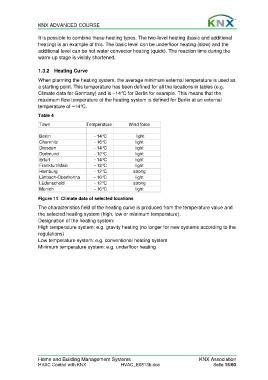
                  When planning the heating system, the average minimum external temperature is used as
                  a starting point. This temperature has been defined for all the locations in tables (e.g.
                  Climate data for Germany) and is –14°C for Berlin for example. This means that the
                  maximum flow temperature of the heating system is defined for Berlin at an external
                  temperature of –14°C.

                  Table 4

                  Town                 Temperature        Wind force

                  Berlin                   - 14°C            light
                  Chemnitz                 - 16°C            light
                  Dresden                  - 14°C            light
                  Dortmund                 - 12°C            light
                  Erfurt                   - 14°C            light
                  Frankfurt/Main           - 12°C            light
                  Hamburg                  - 12°C           strong
                  Limbach-Oberfrohna       - 16°C            light
                  Lüdenscheid              - 12°C           strong
                  Munich                   - 16°C            light
                  Figure 11: Climate data of selected locations
                  The characteristics field of the heating curve is produced from the temperature value and
                  the selected heating system (high, low or minimum temperature).
                  Designation of the heating system:
                  High temperature system: e.g. gravity heating (no longer for new systems according to the
                  regulations)
                  Low temperature system: e.g. conventional heating system
                  Minimum temperature system: e.g. underfloor heating


                  Home and Building Management Systems                                    KNX Association
                  HVAC Control with KNX                HVAC_E0813b.doc                          Seite 15/60

