


Page 110 - Digital Electronics by harish
P. 110
When R/ line is LOW, input buffer is enabled and output buffer is disabled. When
               R/ line is HIGH, input buffer is disabled and output buffer is enabled.


               Write operation:

               1.  By  making  the  R/  line  LOW,  the  input  buffer  is  enabled  and  the  output  buffer  is
                   disabled.
               2.  To write a „1‟
                       a.  DIN line is made HIGH.
                       b.  ROW Select is made HIGH and the transistor is turned ON.
                       c.  Now, the capacitor is charged and stores a „1‟.
               3.  To write a „0‟
                       a.  DIN line is made LOW.
                       b.  ROW Select is made HIGH and the transistor is turned ON.
                       c.  Now, the capacitor is discharged and stores a „0‟.
               4.  When the ROW Select is made LOW, the transistor is switched OFF and the charge on
                   the capacitor is not disturbed.

               Read operation:

               1.  By making the R/ line HIGH, the output buffer is enabled and input buffer is disabled.
               2.  ROW Select line is made HIGH. This turns ON the transistor and connects the capacitor
                   to the DOUT line through the output buffer.

               Refresh operation:

               1.  To  enable  the  Refresh  operation,  R/  line,  ROW  line  and  REFRESH  line  are  made
                   HIGH.
               2.  The transistor is turned ON and the capacitor is connected to COLUMN line.
               3.  As R/ is HIGH, the output buffer is enabled and the stored data bit is applied to the
                   input of the refresh buffer.
               4.  The output of the refresh buffer either „0‟ or „1‟ is applied to the COLUMN line and this
                   maintains the charge on the capacitor.

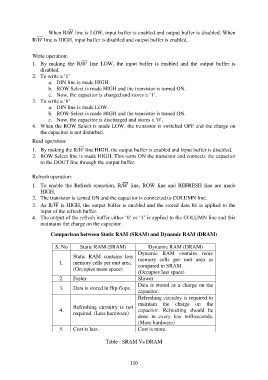
                        Comparison between Static RAM (SRAM) and Dynamic RAM (DRAM)

                          S. No      Static RAM (SRAM)             Dynamic RAM (DRAM)
                                                              Dynamic  RAM  contains  more
                                  Static  RAM  contains  less
                           1.     memory cells per unit area.   memory  cells  per  unit  area  as
                                                              compared to SRAM.
                                  (Occupies more space)
                                                              (Occupies less space)
                           2.     Faster                      Slower
                                                              Data is stored as a charge on the
                           3.     Data is stored in flip-flops.
                                                              capacitor.
                                                              Refreshing circuitry is required to
                                                              maintain  the  charge  on  the
                                  Refreshing  circuitry  is  not
                           4.                                 capacitor.  Refreshing  should  be
                                  required. (Less hardware)
                                                              done  in  every  few  milliseconds.
                                                              (More hardware)
                           5.     Cost is less.               Cost is more.

                                                Table : SRAM Vs DRAM


                                                           110

