


Page 106 - Digital Electronics by harish
P. 106
Control signals:

                       In  addition  to  the  address  and  data  lines,  there  are  some  control  signals  like  Chip
               Select (CS), Read (RD) and Write (WR). CS is used to select the memory chip, only when
               CS is active (CS = 1), the RAM chip will work. WR line used while writing the data into the
               memory  locations  and  RD  line  is  used  while  reading  the  data  from  the  memory  location
               selected by the address inputs.

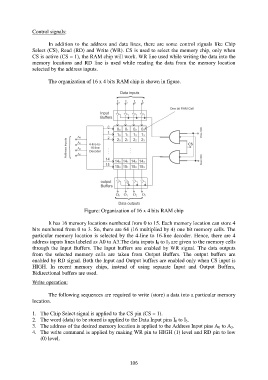
                       The organization of 16 x 4 bits RAM chip is shown in figure.


                                      Figure: Organization of 16 x 4 bits RAM chip

                       It has 16 memory locations numbered from 0 to 15. Each memory location can store 4
               bits numbered from 0 to 3. So, there are 64 (16 multiplied by 4) one bit memory cells. The
               particular memory location is selected by the 4-line to 16-line decoder. Hence, there are 4
               address inputs lines labeled as A0 to A3.The data inputs I 0 to I 3 are given to the memory cells
               through  the  Input  Buffers.  The  Input  buffers  are  enabled  by  WR  signal.  The  data  outputs
               from  the  selected  memory  cells  are  taken  from  Output  Buffers.  The  output  buffers  are
               enabled by RD signal. Both the Input and Output buffers are enabled only when CS input is
               HIGH.  In  recent  memory  chips,  instead  of  using  separate  Input  and  Output  Buffers,
               Bidirectional buffers are used.

               Write operation:

                       The following sequences are required to write (store) a data into a particular memory
               location.

               1.  The Chip Select signal is applied to the CS pin (CS = 1).
               2.  The word (data) to be stored is applied to the Data Input pins I 0 to I 3.
               3.  The address of the desired memory location is applied to the Address Input pins A 0 to A 3.
               4.  The write command is applied by making WR pin to HIGH (1) level and RD pin to low
                   (0) level.


                                                           106

