


Page 146 - Digital Electronics by harish
P. 146
Direct addressing mode

                       In  direct  addressing  mode,  the  address  of  the  operand  is  directly
               specified in the instruction. In this addressing mode, the instruction is two or
               three bytes long. The first byte is the Opcode. The operand may be a 16-bit (2
               bytes) memory address or an 8-bit (1 byte) port address.
               Examples:


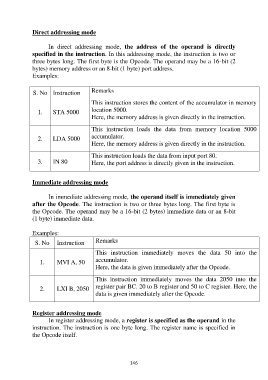
                S. No  Instruction        Remarks
                                          This instruction stores the content of the accumulator in memory

                  1.     STA 5000         location 5000.
                                          Here, the memory address is given directly in the instruction.


                                          This  instruction  loads  the  data  from  memory  location  5000
                  2.     LDA 5000         accumulator.
                                          Here, the memory address is given directly in the instruction.

                                          This instruction loads the data from input port 80.
                  3.     IN 80            Here, the port address is directly given in the instruction.


               Immediate addressing mode

                       In immediate addressing mode, the operand itself is immediately given
               after the Opcode. The instruction is two or three bytes long. The first byte is
               the Opcode. The operand may be a 16-bit (2 bytes) immediate data or an 8-bit
               (1 byte) immediate data.

               Examples:
                 S. No  Instruction        Remarks

                                           This  instruction  immediately  moves  the  data  50  into  the

                   1.     MVI A, 50        accumulator.
                                           Here, the data is given immediately after the Opcode.

                                           This  instruction  immediately  moves  the  data  2050  into  the

                   2.     LXI B, 2050      register pair BC. 20 to B register and 50 to C register. Here, the
                                           data is given immediately after the Opcode.


               Register addressing mode
                       In register addressing mode, a register is specified as the operand in the
               instruction. The instruction is one byte long. The register name is specified in
               the Opcode itself.


                                                           146

