


Page 148 - Digital Electronics by harish
P. 148
5.3     Machine cycle and Instruction cycle


               5.3.1  Machine cycle

                   Machine cycle is defined as the time required for completing one operation
               of accessing memory, I/O or acknowledging an external request. Machine cycle
               is comprised of T-states. T-state is defined as one subdivision of the operation
               performed in one clock period. The following are the various machine cycles of
               8085 microprocessor.

                   1.  Opcode Fetch (OF)
                   2.  Memory Read (MR)
                   3.  Memory Write (MW)
                   4.  I/O Read (IOR)
                   5.  I/O Write (IOW)
                   6.  Interrupt Acknowledge (IA)
                   7.  Bus Idle (BI)
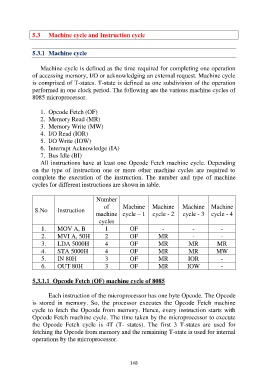
                   All instructions have at least one Opcode Fetch machine cycle. Depending
               on  the  type  of  instruction  one  or  more  other  machine  cycles  are  required  to
               complete  the  execution  of  the  instruction.  The  number  and  type  of  machine
               cycles for different instructions are shown in table.

                                            Number
                                               of       Machine  Machine          Machine  Machine
                S.No       Instruction
                                            machine  cycle – 1  cycle - 2         cycle - 3  cycle - 4
                                             cycles
                   1.      MOV A, B             1          OF            -             -           -
                   2.      MVI A, 50H           2          OF          MR              -           -
                   3.      LDA 5000H            4          OF          MR            MR           MR
                   4.      STA 5000H            4          OF          MR            MR          MW

                   5.      IN 80H               3          OF          MR            IOR           -
                   6.      OUT 80H              3          OF          MR           IOW            -

               5.3.1.1  Opcode Fetch (OF) machine cycle of 8085

                       Each instruction of the microprocessor has one byte Opcode. The Opcode
               is  stored  in  memory.  So,  the  processor  executes  the  Opcode  Fetch  machine
               cycle to fetch the Opcode from  memory. Hence, every instruction starts with
               Opcode Fetch machine cycle. The time taken by the microprocessor to execute
               the  Opcode  Fetch  cycle  is  4T  (T-  states).  The  first  3  T-states  are  used  for
               fetching the Opcode from memory and the remaining T-state is used for internal
               operations by the microprocessor.


                                                           148

