


Page 29 - Digital Electronics by harish
P. 29
1.4     LOGIC GATES

               1.4.1  Logic gates

               A gate is a logic circuit with one output and one or more inputs. The output signal occurs
               only  for  certain  input  combinations.  The  input  and  output  signals  are  digital  in  nature  ie.
               either 0 (low) or 1 (high). All the possible input combinations and their corresponding output
               conditions are noted in a table, called truth table.

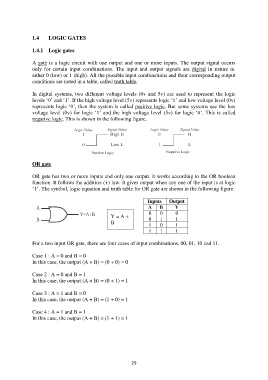
               In digital systems, two different voltage levels (0v and 5v) are used to represent the logic
               levels „0‟ and „1‟. If the high voltage level (5v) represents logic „1‟ and low voltage level (0v)
               represents logic „0‟, then the system is called positive logic. But some systems use the low
               voltage level (0v) for logic „1‟ and the high voltage level (5v) for logic „0‟. This is called
               negative logic. This is shown in the following figure.


               OR gate

               OR gate has two or more inputs and only one output. It works according to the OR boolean
               function. It follows the addition (+) law. It gives output when any one of the input is at logic
               „1‟. The symbol, logic equation and truth table for OR gate are shown in the following figure.

                                                                   Inputs   Output
                                                                   A    B      Y
                                                                   0    0      0
                                                  Y = A +          0    1      1
                                                  B                1    0      1
                                                                   1    1      1

               For a two input OR gate, there are four cases of input combinations, 00, 01, 10 and 11.

               Case 1 : A = 0 and B = 0
               In this case, the output (A + B) = (0 + 0) = 0

               Case 2 : A = 0 and B = 1
               In this case, the output (A + B) = (0 + 1) = 1

               Case 3 : A = 1 and B = 0
               In this case, the output (A + B) = (1 + 0) = 1

               Case 4 : A = 1 and B = 1
               In this case, the output (A + B) = (1 + 1) = 1


                                                           29

