


Page 625 - CarrLaneCatalog_2019ed-c.pdf
P. 625
Design Information


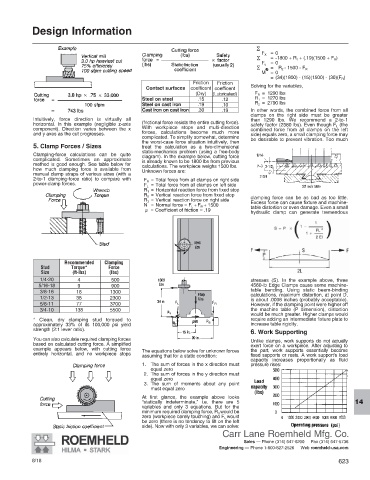
                                                                                      F X  = 0
                                                                                          = -1800 + R 1  + (.19)(1500 + F R )
                                                                                      F y  = 0
                                                                                          =   R 2  - 1500 - F R
                                                                                       M = 0
                                                                                           = (34)(1800) - (15)(1500) - (30)(F R )
                                                                 Friction  Friction
                                                 Contact surfaces  coefficent coefficent  Solving for the variables,
                                                                  (Dry)  (Lubricated)   F R  =  1290 lbs
                                                Steel on steel    .15     .12        R 1  =  1270 lbs
                                                Steel on cast iron  .19   .10        R 2  =  2790 lbs
                                                Cast iron on cast iron  .30  .19    In other words, the combined force from all
                                                                                    clamps on the right side must be greater
            Intuitively, force direction is virtually all                           than 1290 lbs. We recommend a 2-to-1
            horizontal. In this example (negligible z-axis   (frictional force resists the entire cutting force).  safety factor (2580 lbs). Even though F L  (the
            component). Direction varies between the x   With workpiece stops and multi-direction   combined force from all clamps on the left
            and y axes as the cut progresses.   forces, calculations become much more   side) equals zero, a small clamping force may
                                                complicated. To simplify somewhat, determine   be desirable to prevent vibration. Too much
                                                the worst-case force situation intuitively, then
            5. Clamp Forces / Sizes             treat the calculation as a two-dimensional
                                                static-mechanics problem (using a free-body
            Clamping-force calculations can be quite   diagram). In the example below, cutting force
            complicated. Sometimes an approximate   is already known to be 1800 lbs from previous
            method is good enough. See table below for   calculations. The workpiece weighs 1500 lbs.
            how much clamping force is available from   Unknown forces are:
            manual clamp straps of various sizes (with a
            2-to-1 clamping-force ratio) to compare with    F R  = Total force from all clamps on right side
            power-clamp forces.                  F L  = Total force from all clamps on left side
                                                 R 1  = Horizontal reaction force from fixed stop
                                                 R 2  = Vertical reaction force from fixed stop  clamping force can be as bad as too little.
                                                 R 3  = Vertical reaction force on right side  Excess force can cause fixture and machine-
                                                 N   = Normal force = F L  +   F R  + 1500  table distortion or even damage. Even a small
                                                  μ  = Coefficient of friction = .19
                                                                                    hydraulic clamp can generate tremendous


                      Recommended   Clamping
              Stud       Torque*     Force
               Size      (ft-lbs)    (lbs)
              1/4-20       4          500                                           stresses (S). In the example above, three
              5/16-18      9          900                                           4560-lb Edge Clamps cause some machine-
              3/8-16      16         1300                                           table bending. Using static beam-binding
                                                                                    calculations, maximum distortion, at point D,
              1/2-13      38         2300                                           is about .0006 inches (probably acceptable).
              5/8-11      77         3700                                           However, if the clamping point were higher off
              3/4-10      138        5500                                           the machine table (P dimension), distortion
                                                                                    would be much greater. Higher clamps would
            * Clean, dry clamping stud torqued to                                   require adding an intermediate fixture plate to
            approximately 33% of its 100,000 psi yield                              increase table rigidity.
            strength (2:1 lever ratio).
                                                                                    6. Work Supporting
            You can also calculate required clamping forces                         Unlike clamps, work supports do not actually
            based on calculated cutting force. A simplified                         exert force on a workpiece. After adjusting to
            example appears below, with cutting force   The equations below solve for unknown forces   the part, work supports essentially become
            entirely horizontal, and no workpiece stops
                                                assuming that for a static condition:  fixed supports or rests. A work support’s load
                                                                                    capacity increases proportionally as fluid
                                                1.  The sum of forces in the x direction must   pressure rises:
                                                   equal zero
                                                 2.  The sum of forces in the y direction must
                                                   equal zero
                                                 3.  The sum of moments about any point
                                                   must equal zero
                                                At first glance, the example above looks
                                                “statically indeterminate,” i.e. there are 5
                                                                                                                      14
                                                variables and only 3 equations. But for the
                                                minimum required clamping force, R 3  would be
                                                zero (workpiece barely touching) and F L  would
                                                be zero (there is no tendency to lift on the left
                                                side). Now with only 3 variables, we can solve:
                                                                          Carr Lane Roemheld Mfg. Co.
                                                                                 Sales — Phone (314) 647-6200     Fax (314) 647-5736
                                                                         Engineering — Phone 1-800-827-2526     Web roemheld-usa.com
            8/18                                                                                                 623

