


Page 626 - CarrLaneCatalog_2019ed-c.pdf
P. 626
Design Information


        Choose enough load capacity to resist:
        (1) ma  chining forces; (2) workpiece weight; (3)
        clamping forces not resisted by fixed stops.


                                            3. Machine-tool interlock. In automated
                                            systems where timing and synchronization are   via hose, tubing, or drilled passages. When
                                            important, double-acting clamps are the best   hydraulic pressure acts on a clamp’s piston
        When supporting underneath a clamp, as   choice. By installing pressure switches in both   area, it generates external force according
        in the example above, load capacity should   clamping and return lines, a machine controller   to the physical relationship F=P x A:
        be substantially greater than clamping   knows exact clamp status at all times.
        force. Not only must the support resist static
        clamping force, it must resist dynamic load   8.  Clamping Time
        too (the “hammering” due to clamping-arm   Hydraulic clamping is usually fast, but not
        mo men tum). We recommend a load capacity   instantaneous. To estimate clamping time,
        of at least 2 times the clamping force. Another   consider the two phases of clamping:
        factor when clamping over a work support is      1.   Extending time, under low-pressure
        that the clamp may build up force faster than   free flow
        the support builds up load capacity. To avoid      2.  Pressure-building time
        this, use a sequence valve to delay clamping
        until load capacity builds up.
        7.  Single Acting vs. Double Acting                                     Clamping with hydraulics causes some
        The return side of single acting elements,                              strange effects not occurring with manual
        with a few exceptions (small work supports),                            clamps. One such phenomenon is fluid
        require breather ports on the return side,                              shifting between equal-force opposing
        and when used in systems with high flow or                              clamps.
        pressurized cutting fluids/coolants, great care   Extending time is fairly easy to calculate,
        must be taken to ensure that these fluids do not   knowing fluid required by each clamp
        enter the return side of the clamps. It is highly   and the power units flow rate, using the
        recommended that double acting elements   formula below. One obvious way to reduce
        be used in such systems, thus eliminating the   clamping time is to set clamps as close to
        problem, and resultant machine down time.   the workpiece at possible, to use as little
        Double acting clamps should also be used in   stroke as possible.
        systems having an automatic load/unload, so
        that all functions can easily be coordinated.
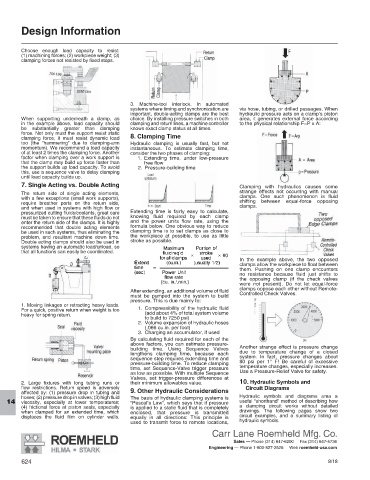
                                                                                In the example above, the two opposed
                                                                                clamps allow the workpiece to float between
                                                                                them. Pushing on one clamp encounters
                                                                                no resistance because fluid just shifts to
                                                                                the opposing clamp (if the check valves
                                                                                were not present). Do not let equal-force
                                                                                clamps oppose each other without Remote-
                                            After extending, an additional volume of fluid   Controlled Check Valves.
                                            must be pumped into the system to build
                                            pressure. This is due mainly to:
        1. Moving linkages or retracting heavy loads.
        For a quick, positive return when weight is too      1.  Compressibility of the hydraulic fluid
        heavy for spring return.                 (add about 4% of total system volume
                                                 to build to 7250 psi)
                                               2.  Volume expansion of hydraulic hoses
                                                 (.066 cu.in. per foot)
                                               3.  Charging an accumulator, if used
                                            By calculating fluid required for each of the
                                            above factors, you can estimate pressure-
                                            building time. Using Sequence Valves   Another strange effect is pressure change
                                            lengthens clamping time, because each   due to temperature change of a closed
                                            sequence step requires extending time and   system. In fact, pressure changes about
                                            pressure-building time. To reduce clamping   80 psi per 1° F! Be careful of excessive
                                            time, set Sequence-Valve trigger pressure   temperature changes, especially increases.
                                            as low as possible. With multiple Sequence   Use a Pressure-Relief Valve for safety.
                                            Valves, set trigger-pressure differences at
        2. Large fixtures with long tubing runs or   their minimum allowables value.  10. Hydraulic Symbols and
        flow restrictions. Return speed is adversely                                Circuit Diagrams
        affected by: (1) pressure drop in tubing and   9.   Other Hydraulic Considerations
        hoses; (2) pressure drop in valves; (3) high fluid   The basis of hydraulic clamping systems is   Hydraulic symbols and diagrams area a
        viscosity, especially at lower temperatures;   “Pascal’s Law”, which says that if pressure   useful “shorthand” method of describing how
   14
        (4) frictional force at piston seals, especially   is applied to a static fluid that is completely   a clamping circuit works without detailed
        when clamped for an extended time, which   enclosed, that pressure is transmitted   drawings. The following pages show two
        displaces the fluid film on cylinder walls.   equally in all directions: This principle is   circuit examples, and a summary listing of
                                            used to transmit force to remote locations,    hydraulic symbols.
                                                                       Carr Lane Roemheld Mfg. Co.
                                                                              Sales — Phone (314) 647-6200     Fax (314) 647-5736
                                                                      Engineering — Phone 1-800-827-2526     Web roemheld-usa.com
        624                                                                                                  8/18

