


Page 203 - Tafsir of surat at tawba repentance
P. 203
© Islamic Online University Usool at-Tafseer
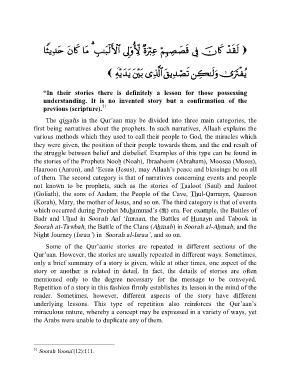
$ZVÏtn tb%x. 3 $tB É=»t6ø9F{$# Í<'rT[{ ×ouö9Ïã öNÎhÅÁ|Ás% Îû c%x. ôs)s9 )
( Ïm÷yt tû÷üt/ Ï%©!$# t,ÏóÁs? `Å6»s9ur 2utIøÿã
“In their stories there is definitely a lesson for those possessing
understanding. It is no invented story but a confirmation of the
51
previous (scripture).
The qissahs in the Qur’aan may be divided into three main categories, the
first being narratives about the prophets. In such narratives, Allaah explains the
various methods which they used to call their people to God, the miracles which
they were given, the position of their people towards them, and the end result of
the struggle between belief and disbelief. Examples of this type can be found in
the stories of the Prophets Nooh (Noah), Ibraaheem (Abraham), Moosaa (Moses),
Haaroon (Aaron), and ‘Eesaa (Jesus), may Allaah’s peace and blessings be on all
of them. The second category is that of narratives concerning events and people
not known to be prophets, such as the stories of Taaloot (Saul) and Jaaloot
(Goliath), the sons of Aadam, the People of the Cave, Thul-Qarnayn, Qaaroon
(Korah), Mary, the mother of Jesus, and so on. The third category is that of events
which occurred during Prophet Muhammad’s (r) era. For example, the Battles of
Badr and Uhud in Soorah Aal ‘Imraan, the Battles of Hunayn and Tabook in
Soorah at-Tawbah, the Battle of the Clans (Ahzaab) in Soorah al-Ahzaab, and the
Night Journey (Israa’) in Soorah al-Israa’, and so on.
Some of the Qur’aanic stories are repeated in different sections of the
Qur’aan. However, the stories are usually repeated in different ways. Sometimes,
only a brief summary of a story is given, while at other times, one aspect of the
story or another is related in detail. In fact, the details of stories are often
mentioned only to the degree necessary for the message to be conveyed.
Repetition of a story in this fashion firmly establishes its lesson in the mind of the
reader. Sometimes, however, different aspects of the story have different
underlying lessons. This type of repetition also reinforces the Qur’aan’s
miraculous nature, whereby a concept may be expressed in a variety of ways, yet
the Arabs were unable to duplicate any of them.
51
Soorah Yoosuf (12):111.
http://www.islamiconlineuniversity.com 26

