


Page 207 - Tafsir of surat at tawba repentance
P. 207
© Islamic Online University Usool at-Tafseer
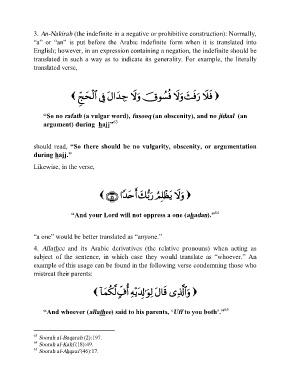
3. An-Nakirah (the indefinite in a negative or prohibitive construction): Normally,
“a” or “an” is put before the Arabic indefinite form when it is translated into
English; however, in an expression containing a negation, the indefinite should be
translated in such a way as to indicate its generality. For example, the literally
translated verse,
( Ædkysø9$# Îû tA#yÅ_ wur XqÝ¡èù wur y]sùu xsù )
“So no rafath (a vulgar word), fusooq (an obscenity), and no jidaal (an
63
argument) during hajj”
should read, “So there should be no vulgarity, obscenity, or argumentation
during hajj.”
Likewise, in the verse,
( ÇÍÒÈ #Ytnr& y7/u ÞOÎ=ôàt wur )
64
“And your Lord will not oppress a one (ahadan).”
“a one” would be better translated as “anyone.”
4. Allathee and its Arabic derivatives (the relative pronouns) when acting as
subject of the sentence, in which case they would translate as “whoever.” An
example of this usage can be found in the following verse condemning those who
mistreat their parents:
( !$yJä3©9 7e$é& Ïm÷t$Î!ºuqÏ9 tA$s% Ï%©!$#ur )
65
“And whoever (allathee) said to his parents, ‘Uff to you both’.”
63
Soorah al-Baqarah (2):197.
64
Soorah al-Kahf (18):49.
65
Soorah al-Ahqaaf (46):17.
http://www.islamiconlineuniversity.com 30

