


Page 225 - Tafsir of surat at tawba repentance
P. 225
© Islamic Online University Usool at-Tafseer
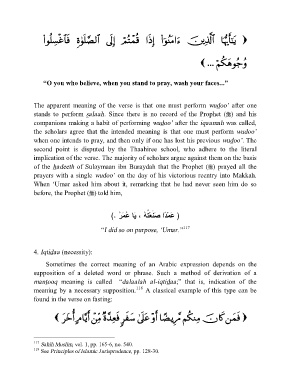
(#qè=Å¡øî$$sù Ío4qn=¢Á9$# n<Î) óOçFôJè% #sÎ) (#þqãYtB#uä úïÏ%©!$# $pkr'¯»t )
( ... öNä3ydqã_ãr
“O you who believe, when you stand to pray, wash your faces...”
The apparent meaning of the verse is that one must perform wudoo’ after one
stands to perform salaah. Since there is no record of the Prophet (r) and his
companions making a habit of performing wudoo’ after the iqaamah was called,
the scholars agree that the intended meaning is that one must perform wudoo’
when one intends to pray, and then only if one has lost his previous wudoo’. The
second point is disputed by the Thaahiree school, who adhere to the literal
implication of the verse. The majority of scholars argue against them on the basis
of the hadeeth of Sulaymaan ibn Buraydah that the Prophet (r) prayed all the
prayers with a single wudoo’ on the day of his victorious reentry into Makkah.
When ‘Umar asked him about it, remarking that he had never seen him do so
before, the Prophet (r) told him,
(. ﺭﻤﻋ ﺎﻴ ، ﻪﹸﺘﻌﹶﻨﺼ ﺍﺩﻤﻋ )
“I did so on purpose, ‘Umar.” 117
4. Iqtidaa (necessity):
Sometimes the correct meaning of an Arabic expression depends on the
supposition of a deleted word or phrase. Such a method of derivation of a
mantooq meaning is called “dalaalah al-iqtidaa;” that is, indication of the
meaning by a necessary supposition. 118 A classical example of this type can be
found in the verse on fasting:
( tyzé& BQ$r& ô`ÏiB ×o£Ïèsù 9xÿy 4n?tã ÷rr& $³ÒÍ£D Nä3ZÏB c%x. `yJsù )
117
Sahih Muslim, vol. 1, pp. 165-6, no. 540.
118
See Principles of Islamic Jurisprudence, pp. 128-30.
http://www.islamiconlineuniversity.com 48

