


Page 227 - Tafsir of surat at tawba repentance
P. 227
© Islamic Online University Usool at-Tafseer
for you; and eat and drink until the white thread of the dawn becomes
distinct to you from the black thread (of the night).” 121
This indicates that it is acceptable to begin the fast in a state of janaabah, 122 since
intercourse is allowable at night up until dawn, possibly leaving no opportunity
for one to regain his or her state of purity by bathing; thus, entering the morning
of a fast in a state of impurity must, of necessity, be allowable.
Mafhoom (Implied) Meanings
There are two types of mafhoom (implied) meanings in relationship to the
rule contained in the mantooq meaning of a statement: the mafhoom al-
muwaafaqah, in which the rule in the implied meaning agrees with that of the
mantooq; and mafhoom al-mukhaalafah, in which the rule in the implied meaning
is the contrapositive of the mantooq. 123 That is, if a law is connected to a
particular condition, trait, number, etc., one can assume the law doesn’t apply
when the condition, trait, number, etc. is missing. Both of these types of mafhoom
meanings have been further subdivided by some scholars; however, the
differences are so linguistically fine that it will suffice to mention a few examples
from each of the two main types here.
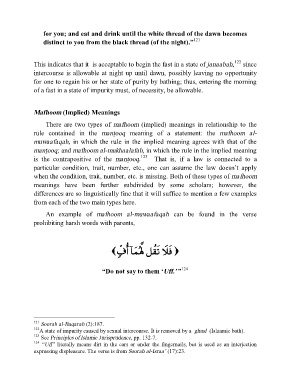
An example of mafhoom al-muwaafaqah can be found in the verse
prohibiting harsh words with parents,
( 7e$é& !$yJçl°; @à)s? xsù )
124
“Do not say to them ‘Uff.’ ”
121
Soorah al-Baqarah (2):187.
122
A state of impurity caused by sexual intercourse. It is removed by a ghusl (Islaamic bath).
123
See Principles of Islamic Jurisprudence, pp. 132-7.
124
“Uff” literally means dirt in the ears or under the fingernails, but is used as an interjection
expressing displeasure. The verse is from Soorah al-Israa’ (17):23.
http://www.islamiconlineuniversity.com 50

