


Page 110 - D&D - Player's Handbook
P. 110
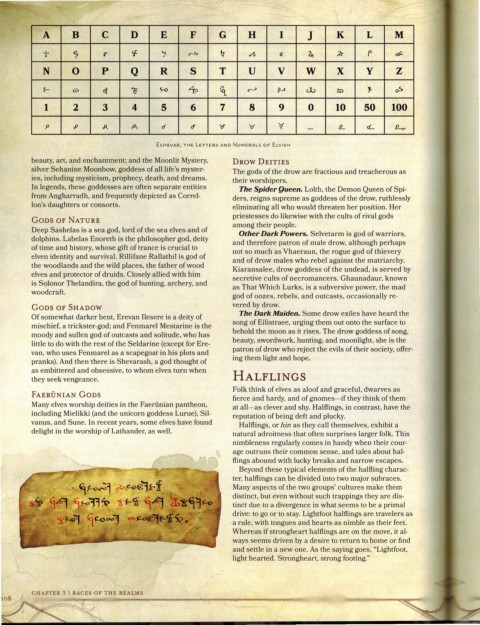
A      B      c       D      E      F       G      H       I      J      K      L      M

            T      '?      '1'    cf     ';!    ~       q      A       c;;    ~      ~       f     '*'

            N      0      p       Q      R      s       T      u      v      w       x      y       z

            f-     (i)     q      12     S-0    ~       <q,    .--J   p      cl;>    cu     1"     oS
            1      2       3      4      5       6      7      8      9       0      10     50    100


            ,P     i'      A      A      cf      <f     'ti'   'O     v      -       E._    cL     E..+
                                        E s PRUAR ,  THE  LETT E R S  AND  NU ME RAL S  O F  E LV IS H
         beauty, art, and enchantment; and the Moonlit Mystery,   DROW DEITIES
         silver Sehanine Moonbow, goddess of all life's myster-  The gods of the drow are fractious and treacherous as
         ies, including mysticism, prophecy, death, and dreams.
                                                           their worshipers.
         In legends, these goddesses are often separate entities
                                                             The Spider Queen. Lolth, the Demon Queen of Spi-
         from Angharradh, and frequently depicted as Correl-
                                                           ders, reigns supreme as goddess of the drow, ruthlessly
         lon's daughters or consorts.                      eliminating all who would threaten her position. Her
                                                           priestesses do likewise with the cults of rival gods
         GODS OF NATURE
                                                           among their people.
         Deep Sashelas is a sea god, lord of the sea elves and of
                                                             Other Dark Powers. Selvetarm is god of warriors,
         dolphins. Labelas Enoreth is the philosopher god, deity
                                                           and therefore patron of male drow, although perhaps
         of time and history, whose gift of trance is crucial to
                                                           not so much as Vhaeraun, the rogue god of thievery
         elven identity and survival. Rillifane Rallathil is god of
                                                           and of drow males who rebel against the matriarchy.
         the woodlands and the wild places, the father of wood
                                                           Kiaransalee, drow goddess of the undead, is served by
         elves and protector of druids. Closely allied with him
                                                           secretive cults of necromancers. Ghaunadaur, known
         is Solonar Thelandira, the god of hunting, archery, and
                                                           as That Which Lurks, is a subversive power, the mad
         woodcraft.
                                                           god of oozes, rebels, and outcasts, occasionally re-
                                                           vered by drow.
         GODS OF SHADOW
                                                             The Dark Maiden. Some drow exiles have heard the
         Of somewhat darker bent, Erevan Ilesere is a deity of
                                                           song of Eilistraee, urging them out onto the surface to
         mischief, a trickster-god; and Fenmarel Mestarine is the
                                                           behold the moon as it rises. The drow goddess of song,
         moody and sullen god of outcasts and solitude, who has
                                                           beauty, swordwork, hunting, and moonlight, she is the
         little to do with the rest of the Seldarine (except for Ere-
                                                           patron of drow who reject the evils of their society, offer-
         van  who uses Fenmarel as a scapegoat in his plots and
                                                           ing them light and hope.
         pra~ks). And then there is Shevarash, a god thought of
         as embittered and obsessive, to whom elves turn when
         they seek vengeance.                              HALFLINGS
                                                           Folk think of elves as aloof and graceful, dwarves as
         FAERUNIAN  GODS
                                                           fierce and hardy, and of gnomes- if they think of them
         Many elves worship deities in the Faerfinian pantheon,   at all- as clever and shy. Halflings, in contrast, have the
         including Mielikki (and the unicorn goddess Lurue), Sil-  reputation of being deft and plucky.
         vanus, and Sune. In recent years, some elves have found   Halflings, or hin as they call themselves, exhibit a
         delight in the worship of Lathander, as well.     natural adroitness that often surprises larger folk. This
                                                           nimbleness regularly comes in handy when their cour-
                                                           age outruns their common sense, and tales about hal-
                                                           flings abound with lucky breaks and narrow escapes.
                                                             Beyond these typical elements of the halfling charac-
                                                           ter, halflings can be divided into two major subraces.
                                                           Many aspects of the two groups' cultures make them
                                                           distinct, but even without such trappings they are dis-
                                                           tinct due to a divergence in what seems to be a primal
                                                           drive: to go or to stay. Lightfoot halflings are travelers as
                                                           a rule, with tongues and hearts as nimble as their feet.
                                                           Whereas if strongheart halflings are on the move, it al-
                                                           ways seems driven by a desire to return to home or find
                                                           and settle in a new one. As the saying goes, "Lightfoot,
                                                           light hearted. Strongheart, strong footing."

         CHAPTER 3  I RACES  OF THE R:.:E.:.A.,;:L;;.M;.;s _______ .... ~-------r-.-.:""oe~-

