


Page 28 - D&D - Player's Handbook
P. 28
speech, and cramped, ink-stained fingers. Wizards   BESHABA
         invoke Azuth when they scribe scrolls, inscribe magic
                                                           The Maid of Misfortune, Lady Doom, Black Bess
         circles, attempt to memorize spells, and even when they
         cast spells. Often this acknowledgment comes in the   Beshaba is the counterpoint to Tymora and is just as
         form of silently forming Azuth's holy symbol, pointing   frequently acknowledged in daily life as is her more be-
         the index finger of the left hand to the sky. For many wiz-  nevolent "sister." She is seen as a cruel and capricious
         ards, the gesture is so commonplace in their lives that it   goddess who must be propitiated to avoid attracting her
         becomes an unconscious habit.                     attention and interest in a negative way.
          Temples dedicated to Azuth are scarce, and clerics of   Beshaba's name is invoked when someone is beset by
         the deity are extremely rare. Even in magic-saturated   bad luck-which could be as minor as stubbing a toe or
         Halruaa, only a handful of holy places are dedicated to   breaking a wagon wheel, or as catastrophic as slipping
         Azuth. Sometimes a statue or a shrine dedicated to him   and accidentally falling off a cliff. It is also invoked to
         stands in a corner of a temple to Mystra or another deity.   ward off her attentions when someone is doing some-
         More often, a wizard has a personal shrine at home.   thing in which good luck wouldn't play a part but bad
         Azuth is represented at such sites as a hooded and   luck might. For example, someone rolling dice would
         bearded figure with left hand held high, finger pointed   invoke Tymora because they want random chance to
         up. Sometimes he is represented by merely the hand. In   fall in their favor, but someone about to cross a rickety
         either case, the finger often serves as a candleholder or   bridge would ask Beshaba to keep the bridge intact.
         as the point of origin for a light spell.          Folk make the symbol of Beshaba by folding in their
                                                           thumbs and extending their fingers on one or both
         BANE                                              hands (mimicking the horns of her holy symbol) to ward
                                                           off misfortune. The same gesture raised to the head
         The Black Hand,  the Lord of Darkness
                                                           signifies a salute; when pointed at someone, the "horns"
         Bane has a simple ethos: the strong have not just the
                                                           indicate ill favor directed toward that individual.
         right but the duty to rule over the weak. A tyrant who
                                                            Many druids worship Beshaba as one of the First
         is able to seize power must do so, for not only does the   Circle. They propitiate her with dances while wearing
         tyrant benefit, but so do those under the tyrant's rule.   fire-blackened antlers dipped in blood. According to
         When a ruler succumbs to decadence, corruption, or de-  these druids, her holy symbol is the horns of a stag be-
         crepitude, a stronger and more suitable ruler will rise.   cause when Beshaba was first worshiped, humans were
          Bane is vilified in many legends. Throughout history,
                                                           simple hunter-gatherers and she was believed to bring
         those who favor him have committed dark deeds in his
                                                           misfortune to hunters, such as being gored by a stag.
         name, but most people don't worship Bane out of mal-  Although most people tremble in fear at the prospect
         ice. Bane represents ambition and control, and those   of Beshaba's attendance at any event (even in spirit),
         who have the former but lack the latter pray to him to
                                                           Beshaba is almost always invoked and welcomed
         give them strength. It is said that Bane favors those who   formally in the opening speeches or ceremonies of
         exhibit drive and courage, and that he aids those who
                                                           formal functions such as marriages and coronations,
         seek to become conquerors, carving kingdoms from the
                                                           contests of sport or martial prowess, and at the naming
         wilderness, and bringing order to the lawless.    ceremonies of children. If she isn't invited to such an
          At many times and in many places in Faen1n, the   event, she might take offense and wreak misfortune on
         faithful of Bane have been seen as saviors for their ef-  those involved.
         forts in slaughtering raiders, throwing down corrupt rul-  Temples to Beshaba are virtually unknown. It's com-
         ers, or saving armies on the brink of defeat. But in just   mon, however, for rural folk to erect a post and mount
         as many other places, the worship of Bane has created
                                                           antlers on it at the site of some roadside accident or
         or supported cruel dictatorships, aided mercantile mo-
                                                           murder. In cities, where antlers are hard to come by and
         nopolies, or brought about the practice of slavery where
                                                           murders and accidents more prevalent, the fashion is to
         before it didn't exist.
                                                           draw the black antlers of Beshaba with charcoal on a
                                                           nearby wall, leaving the symbol on display until weather
                                                           scours it away. These "shrines," in either form, serve as
                                                           warnings to others about places of ill fortune.
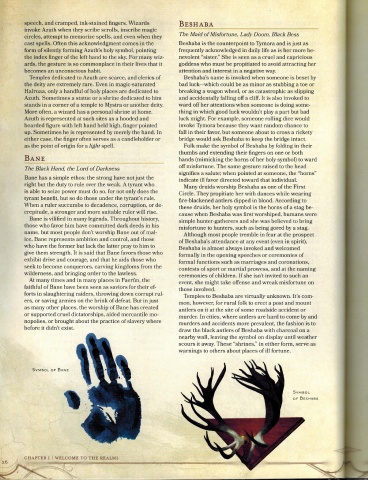
           S Y MB O L  O F  BAN E


         CHAPTER 1  I WELCOME TO THE REALMS

