


Page 29 - D&D - Player's Handbook
P. 29
More formal shrines to Beshaba exist in places where   THE  EARTHMOTHER
           folk frequently hope to ward off misfortune. These sites   The druids of the Moonshae Isles worship the Earth-
           tend to be posts or stones painted red with blackened   mother, she who is the generative power of the land  itself.
           antlers attached to them, or a red, triangular wall-  To  some mainlanders, the Earthmother is  an aspect or
           mounted plaque with attached antlers. Both types have   manifestation of Chauntea, but to the Ffolk,  she is simply
           a stone or bronze bowl where coins can be tossed or   the Earth mother, and always will  be. The moonwells of the
           burnt offerings made. The Red Wizards of Thay com-  isles are her sacred sites and  her windows onto the world.
                                                               See "Druids" in  chapter 4 for  more information.
           monly erect such shrines outside their ritual chambers
           to guard against unfortunate mistakes.
                                                             welcomed into all homes at mealtimes and at the birth
            Few dare to take Beshaba as a patron. The rare cler-
                                                             of children, and folk give her thanks whenever they
           ics of the Maid of Misfortune are those who have been
                                                             experience the pleasure of settling by a fire and feeling
           deeply affected by great misfortunes and who seek to
                                                             safe and loved.
           warn others of the essential unfairness of life- or to in-
                                                              Chauntea's faith is one of nurturing and growth. Agri-
           flict that unfairness upon them.
                                                             cultural aphorisms and farming parables dot her teach-
           BHAAL                                             ings. Growing and reaping, the eternal cycle, is a com-
                                                             mon theme in the faith. Destruction for its own sake, or
           The Lord of Murder
                                                             leveling without rebuilding, is anathema to her.
           The folk of Faerfm don't normally pray to or acknowl-  Temples of Chauntea maintain a great body of lore
           edge Bhaal. He is seen as a deeply evil and destructive   about farming and cultivation. Her priests work closely
           deity who hungers for death- meaning the death of any   with communities in rural areas, and they are willing to
           sentient beings through unlawful means.           roll up their sleeves and dig their hands into the dirt.
            Some people pray to Bhaal when they want to commit
           murder. A person might have good reason to resort to   CYR IC
           murder, such as when one is unable to redress some in-  The Prince of Lies, the Dark Sun
           justice through lawful means. But it's far more common
           for prayers to Bhaal to be uttered by those who seek to   The worship of Cyric derives directly from the story of
           kill someone out of jealousy, greed, or wrath. It's rare for   his ascension to godhood. Cyric was a mortal during the
           anyone but assassins or compulsive killers to take Bhaal   Time of Troubles and the key to how that chaotic period
                                                             resolved, but he was also a selfish traitor and a mur-
           as a patron, and clerics who revere Bhaal often qualify
           on both counts.                                   derer. When he became a god, Cyric continued to work
            Murder cults of Bhaal have arisen in the past, each   various plots of deceit and murder- the most famous of
           led by a charismatic, self-styled priest of Bhaal, but or-  which is that, according to legend, Cyric murdered Mys-
           ganized worship of the Lord of Murder is extremely un-  tra and thus caused the Spellplague over a century ago.
           common. Temples and shrines are similarly rare. Those   Those who don't worship Cyric see him as a god of
           who erect a shrine to Bhaal usually do so to thank him   madness, strife, and deceit, although his priests con-
           for a successful murder. Such shrines typically feature   sider such claims to be heresy. Their Prince of Lies
           a skull or a severed head surrounded by drops of blood   isn't a twisted madman, but a god of dark majesty who
           (often both from the murdered victim).            proves that, ultimately, all bonds between folk corrupt
                                                             and wither away.
           CHAUNTEA                                           Cyric's church works openly in Arnn, where the citi-
                                                             zens espouse the principles of ambition, self-reliance,
           The Great Mother, the Grain Goddess
                                                             and "buyer beware." Those who take Cyric as their
           Chauntea is goddess of agriculture: sowing and reaping,   patron tend to be sadists, con artists, power-mad conniv-
           seeding and harvest, breeding and butchery, shearing   ers, and worse. Other folk pray to Cyric when they want
           and weaving. In this aspect she is a rural deity rarely   to do wrong but don't want others to find out about it.
           prayed to behind the walls of a city except by kitchen   "The Dark Sun," originally one of Cyric's epithets, has
           gardeners. But Chauntea is also the Great Mother, a   become a metaphor for strife in the Realms. "A Dark
           goddess of crib, hearth, and home. And as such she is   Sun has risen o'er this court" might be spoken as a


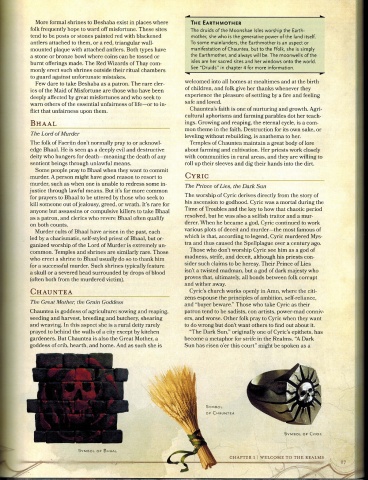
                                                                    SYM BO L
                                                                   OF  (H AU N TEA


                                                                                             SYM BOL  OF  CYRIC


                          SYMBOL  O F  B HAAL

