


Page 32 - D&D - Player's Handbook
P. 32
is given credit. When one hears three rolls of thunder   provide succor when they can, but also use force to
         in succession, it is thought to be a sign from Hoar that   put an end to torture and suffering inflicted on others.
         some act of.vengeance has been performed. Many    Ilmater's priests travel to places where the worst pos-
         human societies have the custom of ringing a bell or a   sible conditions exist, ministering to the needs of the
         gong three times when judgment of a crime is rendered   oppressed, the deceased, and the poor. They put others
         or an execution takes place.                      ahead of themselves, are sharing of all they have, and
           Folk speak Hoar's name when they want revenge,   emphasize the spiritual nature of life over the welfare of
         particularly when they are incapable of avenging them-  the material body.
         selves. This invocation might be in response to a petty   Priests of Ilmater who are on a quest to aid others
         slight or a true injustice, and the acknowledgment of   can be recognized by their hair shirts, vests of coarse
         Hoar might be a short prayer said aloud or might be   fur worn against the bare skin. It is taboo to harm such
         written down somewhere. It's generally believed that   priests as they go about their duties, such as when they
         the more permanent the form of the prayer, the more   administer to the wounded on a battlefield. The taboo is
         likely it is to be fulfilled. For this reason, some etch   so strongly felt among humans that other races respect
         their prayers in lead and bury it or hide their prayers   the custom. Even ores and goblinoids will avoid directly
         inside diaries. Aside from bounty hunters and those on   attacking a peaceful priest of Ilmater, as long as the
         crusades of vengeance, few truly revere Hoar, and he is   priest administers to their fallen warriors as well.
         served by fewer still who would call themselves priests.   Most folk deeply respect the work and the sacrifice
         Temples or shrines of Hoar are almost nonexistent ex-  of Ilmater's faith, and lend aid to such endeavors where
         cept for ancient sites in Chessenta and Unther.   they can. When a temple of Ilmater sends its faithful to
           Hoar became a member of the Faerfinian pantheon   help refugees of war or victims of plague, their willing-
         when his worship extended beyond the lands that origi-  ness to sacrifice their own well-being always prompts
         nally revered him. Most consider Tyr to be the arbiter of   ordinary people to support them, whether they are in-
         laws, and Hoar to be the god who metes out punishment   spired or shamed into action.
         that comes as a result of breaking those codes. A judge
         might favor the worship of Tyr, while a jail or or a heads-  ERG AL
         man is more likely to pray to Hoar.
                                                           The Final Scribe, the Pitiless One, the Bleak Seneschal
         lLMATER                                           Legend has it thatJergal is an ancient deity. The story
                                                           goes that in the time of Netheril he was worshiped as
         The Crying God,  the Rack-Broken Lord, He Who
                                                           the god of death, murder, and strife. Yet with the passing
         Endures
                                                           of time, he became bored with his position. Then one
         Ilmater is the god of suffering, martyrdom, and perse-  day three mortals, each a powerful adventurer, metJer-
         verance, renowned for his compassion and endurance.   gal in the lands of the dead, determined to destroy him
         It is he who offers succor and calming words to those   and take his power. Instead,Jergal calmly abdicated his
         who are in pain, victimized, or in great need. He is the   throne of bones and allowed each of the three mortals to
         willing sufferer, the one who takes the place of another   take part of his divinity. Thus it was that Bane assumed
         to heft the other's burden, to take the other's pain. He is   the portfolio of strife, Myrkul the rulership of the dead,
         the god of the oppressed and the unjustly treated.   and Bhaal the portfolio of murder.] ergal lost his former
           It is said that if he had his way, the Crying God would   stature and became a scribe of the dead.
         take all the suffering in the world onto himself, so as to   Jergal is now seen as an uncaring custodian of the
         spare others. Since he can't, he blesses those who endure   dead. He is thought to record the passing of the living
         on others' behalf, and he alleviates suffering when he can.   and to aid Kelemvor in seeing that souls are properly
         Martyrs who die that others may live are always blessed   bound to their appropriate afterlife. He is rarely ac-
         by II mater with a final rest and reward in the god's after-  knowledged directly, except for being mentioned at
         life, should they so choose.                      funerals and among those who practice the custom of
           Ilmater's priests take in the ill, the starving, and the   writing the name of the deceased on a sheet of parch-
         injured, and his temples give most of what they receive   ment and placing it in the corpse's mouth. This rite is
         to help offset the suffering of the world. His followers


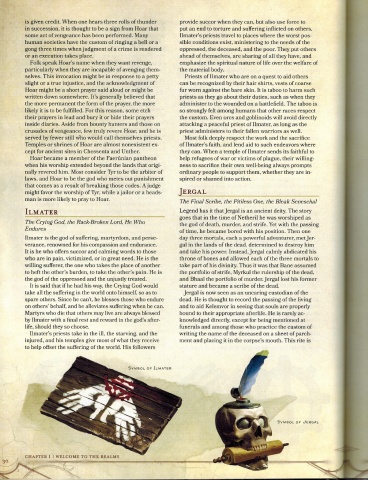
                                           SYMBOL  OF  lLMATER


                                                                                           SYMBOL  OF  JERGAL


         CHAPTER 1  I WELCOME TO THE  REALMS

