


Page 19 - Drug Discovery and Development: Prospects and Challenges
P. 19
Drug Discovery and Development: Prospects and Challenges  /  9

             stage in drug discovery and development (Аrbаin et al., 2021). Most drug
             products fail to reach the market due to two reasons, the first is that they
             do not work and the second is that they are not safe (Hughes et al., 2011).
 Brothers and sisters,
             Brothers and sisters,
 Ladies and Gentlemen,
             Ladies and Gentlemen,


 JOURNEY IN RESEARCH: A PERSONAL EXPERIENCE
                  Journey in Research: A Personal Experience
 Isolation and Characterisation Studies
                         Isolation and Characterisation Studies
      We have successfully isolated and characterised several compounds from different plants
             We have successfully isolated and characterised several compounds from
 throughout our research journey using chromatography and spectroscopic methods. At the beginning
             different plants throughout our research journey using chromatography
 of the experiential research, we focused on Rubiaceae and Guttiferae families. As a young researcher,
             and spectroscopic methods. At the beginning of the experiential research,
             we focused on Rubiaceae and Guttiferae families. As a young researcher,
 it was very exciting to work on natural products.  The  first impression at that time was on  the
             it was very exciting to work on natural products. The first impression at
 Ophiorrhiza species. This species was a research interest of former supervisor Professor Dayar Arbain
             that time was on the Ophiorrhiza species. This species was a research
             interest of former supervisor Professor Dayar Arbain of Universitas
 of Universitas Andalas. Ophiorrhiza species is a member of the Rubiaceae family. The first compound
             Andalas. Ophiorrhiza species is a member of the Rubiaceae family.
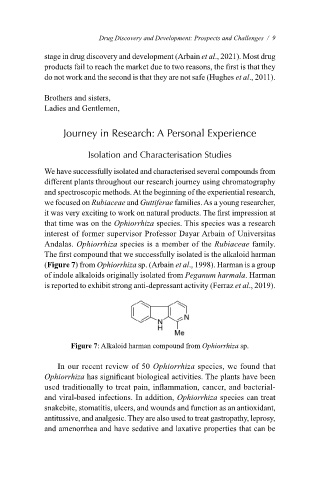
 that we successfully isolated is the alkaloid harman (Figure 7) from Ophiorrhiza sp. (Arbain et al.,
             The first compound that we successfully isolated is the alkaloid harman
 1998). Harman is a group of indole alkaloids originally isolated from Peganum harmala. Harman is
             (Figure 7) from Ophiorrhiza sp. (Arbain et al., 1998). Harman is a group
             of indole alkaloids originally isolated from Peganum harmala. Harman
 reported to exhibit strong anti-depressant activity (Ferraz et al., 2019).
             is reported to exhibit strong anti-depressant activity (Ferraz et al., 2019).


                    Figure 7: Alkaloid harman compound from Ophiorrhiza sp.
                  Figure 7: Alkaloid harman compound from Ophiorrhiza sp.
                 In our recent review of 50 Ophiorrhiza species, we found that
             Ophiorrhiza has significant biological activities. The plants have been
      In our recent review of 50 Ophiorrhiza species, we found that Ophiorrhiza has significant
             used traditionally to treat pain, inflammation, cancer, and bacterial-
 biological activities. The plants have been used traditionally to treat pain, inflammation, cancer, and
             and viral-based infections. In addition, Ophiorrhiza species can treat
             snakebite, stomatitis, ulcers, and wounds and function as an antioxidant,
 bacterial- and viral-based infections. In addition, Ophiorrhiza species can treat snakebite, stomatitis,
             antitussive, and analgesic. They are also used to treat gastropathy, leprosy,
 ulcers, and wounds and function as an antioxidant, antitussive, and analgesic. They are also used to
             and amenorrhea and have sedative and laxative properties that can be
 treat gastropathy, leprosy, and amenorrhea  and have  sedative and laxative  properties that can be

 extracted from their root barks. Overall, the Ophiorrhiza species possess a wide range of biological
 activities and phytochemical constituents, as shown in Figure 8 (Krishnan et al., 2014; Midhu et al.,
 2019; Taher et al., 2020).


                                                                                         14

