


Page 34 - Drug Discovery and Development: Prospects and Challenges
P. 34
Biopharmaceutical Classification System  (BCS)  is an experimental technique  to determine the
      permeability and solubility of a particular product under controlled settings. Based on their aqueous
      solubility and intestinal permeability, the drugs are classified into four classes. In addition to the BCS
      classification, the input from pre-formulation studies would benefit the formulation by providing a
      detailed solubility profile, polymorph status, intended dosage form, target dose, dosing schedule, drug
      stability, excipient compatibility, and understanding of the transporter and metabolic pathways.
           Drugs in BCS are classified as high permeability but low solubility. In order to improve the
      performance of these drugs, a special technique is required to increase the surface area, such as particle
      size reduction, using a solid solution, or solid dispersion. Nowadays, new technologies are available
      to modify the formulation using solvents and/or surfactants. One of the strategies is to encapsulate the
      drugs with Nanotechnology Drug Delivery System (NDDS) (Figure 20). NDDS refers to a material
      that has at least one dimension that falls under the nanometer scale (1–100 nm) or is made with basic
      units in three-dimensional space (Deng, 2020).
           Nanotechnology has become a  useful tool  to  regulate  the delivery rate  and target the drug
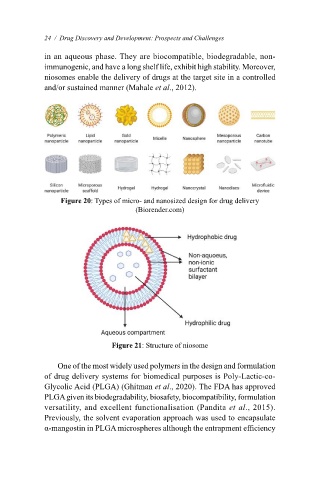
      delivery to a specific location, such as using vesicle nanocarrier, for instance, liposomes and niosomes.
      Liposome comprises cholesterol and phospholipid, while niosome uses cholesterol and non-ionic
      surfactant. The active principle in liposomes and niosome involves the encapsulation of the drug in
      vesicle components of hydrophilic and hydrophobic areas. Niosome (Figure 21) is made up of bilayer
             24  /  Drug Discovery and Development: Prospects and Challenges
      structures and formed by self-association of non-ionic surfactant and cholesterol in an aqueous phase.
      They are biocompatible, biodegradable, non-immunogenic, and have a long shelf life, exhibit high
             in an aqueous phase. They are biocompatible, biodegradable, non-
      stability. Moreover, niosomes enable the delivery of drugs at the target site in a controlled and/or
             immunogenic, and have a long shelf life, exhibit high stability. Moreover,
      sustained manner (Mahale et al., 2012).
             niosomes enable the delivery of drugs at the target site in a controlled
              and/or sustained manner (Mahale et al., 2012).


                 Figure 20: Types of micro- and nanosized design for drug delivery (Biorender.com)
                 Figure 20: Types of micro- and nanosized design for drug delivery

                                      (Biorender.com)

                                                                           29


                               Figure 21: Structure of niosome
                                  Figure 21: Structure of niosome

                 One of the most widely used polymers in the design and formulation
                 One of the most widely used polymers in the design and formulation of drug delivery systems
             of drug delivery systems for biomedical purposes is Poly-Lactic-co-
           for biomedical purposes is Poly-Lactic-co-Glycolic Acid (PLGA) (Ghitman et al., 2020). The FDA
             Glycolic Acid (PLGA) (Ghitman et al., 2020). The FDA has approved
             PLGA given its biodegradability, biosafety, biocompatibility, formulation
           has approved PLGA given its biodegradability, biosafety, biocompatibility, formulation versatility,
             versatility, and excellent functionalisation (Pandita et al., 2015).
           and excellent functionalisation (Pandita et al., 2015). Previously, the solvent evaporation approach
             Previously, the solvent evaporation approach was used to encapsulate
           was used to encapsulate α-mangostin in PLGA microspheres although the entrapment efficiency was
             α-mangostin in PLGA microspheres although the entrapment efficiency
           low. Considering that α-mangostin is soluble in organic solvent due to its hydrophobic nature, the
           microsphere formulation could be a potential α-mangostin micro-carrier delivery system to treat lung
           tissue cancer (Ali et al., 2013).
                Although oral intake is the most preferable route of drug delivery, more than 70% of the active
           pharmaceutical ingredients are poorly water-soluble or lipophilic compounds, which  prevent them
           from  reaching the desired efficacy.  As a  result, the  bioavailability of poorly soluble drugs is
           significantly affected. These compounds are typically grouped as BCS class II or class IV compounds
           (Anwer et al., 2021). To improve the rate of absorption and solubility, the Self-Nanoemulsifying Drug
           Delivery System (SNEDDS) was developed  as an alternative  formulation  method. SNEDDS  is a
           relatively new emulsion technology with the purpose to improve the rate and extent of absorption of
           poorly water-soluble drugs. SNEDDS are anhydrous homogeneous liquid mixtures composed of


                                                                              30

