


Page 7 - GeoPRISMS_Newsletter_Spring2018_Neat
P. 7
Slow slip and future earthquake potential in


           New Zealand and Cascadia


          Noel Bartlow (University of Missouri), Laura Wallace (UT Austin & GNS Science),
          Ryan Yohler (University of Missouri), and Charles Williams (GNS Science)


                                                     he New Zealand and Cascadia subduction zones are two GeoPRISMS primary
       A                                             sites that have captured the interest of geophysicists from around the world. Both
      36°S                                     Tsubduction zones feature significant geological hazards, including the potential for
                                               large earthquake ruptures and tsunamis. In New Zealand, the capital city of Wellington
                                               sits directly atop a large patch of the main subduction plate interface which is frictionally
       39°S                                    locked, with the potential to rupture in future earthquakes. In Cascadia, there is also
                                               potential for a large earthquake on the main subduction interface, which may impact
        42°S                                   cities such as Portland, OR and Seattle, WA.
                                               Both New Zealand and Cascadia also host slow slip events (SSEs). Slow slip events consist
                                               of slip on the subduction plate interface – just as would occur in an earthquake – except the
        45°S
                                               slip takes place more slowly than it would during an earthquake. Now that slow slip events
                                               are widely recognized at many subduction zones, it is critical to better understand their role
         48°S                                  in the accommodation of plate motion. Many questions also exist regarding implications
           165°E  168°E  171°E  174°E  177°E  180°W  of slow slip for subduction zone mechanics, and the relationship between slow slip events
                                               and seismic slip events on the plate boundary.
       B
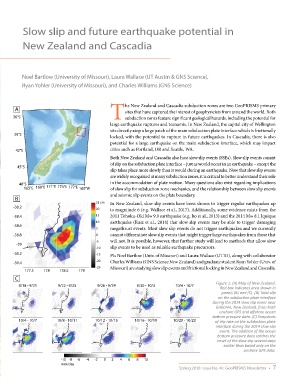
                                         25 cm  In New Zealand, slow slip events have been shown to trigger regular earthquakes up
       -38.2
                                         20    to magnitude 6 (e.g. Wallace et al., 2017). Additionally, some evidence exists from the
       -38.4                             15    2011 Tohoku-Oki Mw 9.0 earthquake (e.g. Ito et al., 2013) and the 2014 Mw 8.1 Iquique
                                         10    earthquake (Ruiz et al., 2014) that slow slip events may be able to trigger damaging
       -38.6
                                         5     megathrust events. Most slow slip events do not trigger earthquakes and we currently
       -38.8                             0     cannot differentiate slow slip events that might trigger large earthquakes from those that
                                         -5    will not. It is possible, however, that further study will lead to methods that allow slow
        -39
                                         -10   slip events to be used as reliable earthquake precursors.
       -39.2                             -15   PIs Noel Bartlow (Univ. of Missouri) and Laura Wallace (UTIG), along with collaborator

       -39.4                             -20   Charles Williams (GNS Science New Zealand) and graduate student Ryan Yohler (Univ. of
                                         -25   Missouri) are studying slow slip events and frictional locking in New Zealand and Cascadia.
           177.5   178    178.5   179
       C
                                                                                           Figure 1. (A) Map of New Zealand.
         9/18 - 9/21     9/22 - 9/25      9/26 - 9/29     9/30 - 10/3     10/4 - 10/7
                                                                                             Red box indicates area shown in
                                                                                              panels (B) and (C). (B) Total slip
                                                                                            on the subduction plate interface
                                                                                          during the 2014 slow slip event near
                                                                                           Gisborne, New Zealand, from both
                                                                                             onshore GPS and offshore ocean
                                                                                          bottom pressure data. (C) Snapshots
         10/4 - 10/7     10/8 - 10/11    10/12 - 10/15   10/16 - 10/19   10/20 - 10/23     of slip rate on the subduction plate
                                                                                           interface during the 2014 slow slip
                                                                                             event. The addition of the ocean
                                                                                            bottom pressure data catches the
                                                                                            onset of the slow slip several days
                                                                                              earlier than based only on the
                                                                                                       onshore GPS data.

                          -10    -8      -6       -4       -2        0       2        4        6        8       10
                          mm/day
                                                                            Spring 2018  Issue No. 40  GeoPRISMS Newsletter  •  7

