


Page 12 - GeoPRISMS_Newsletter_Spring2018_Neat
P. 12
Volatile cycling through the Hikurangi forearc,


        New Zealand


        Jaime D. Barnes (UT Austin), Jeffrey Cullen (UT Austin), Shaun Barker (Univ. of Waikato), Samuele
        Agostini (Istituto di Geoscienze e Georisorse), Sarah Penniston-Dorland (Univ. of Maryland),
        John C. Lassiter (UT Austin), Andreas Klügel (Univ. of Bremen), Laura Wallace (UT Austin & GNS
        Science), Wolfgang Bach (Univ. of Bremen)


                                          uch work has focused on defining the elemental concentration and isotopic composition of
                                          subduction zone inputs (e.g., sediments, altered oceanic crust, serpentinites), as well as outputs
                                  M(e.g., volcanic gases and melt inclusions), in order to assess global cycling of volatiles. However,
                                  with most work focused on outputs from the volcanic front, poor constraints on the geochemistry of forearc
                                  outputs hamper global volatile flux calculations. In fact, most global flux calculations ignore contributions
                                  from the forearc because their outputs and the subducted sources contributing to the fore-arc outputs
                                  are poorly constrained (e.g., Barnes et al., 2018). The Hikurangi margin of New Zealand has a largely
                                  subaerial forearc which hosts numerous fore-arc seeps and springs (Fig. 1). This portion of the forearc is
                                  typically submerged beneath the ocean at most other subduction zones. Easy access to fore-arc springs
                                  along the margin allows for quantification of volatile flux and sources through the shallow portion of the
                                  subduction system (< 50 km).
                                  In addition, there are dramatic along strike variations in subduction parameters along the length of the
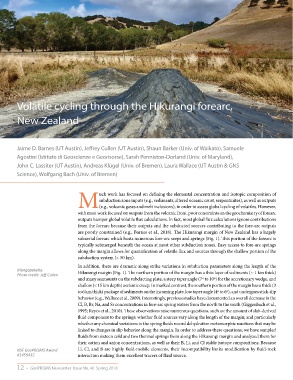
        Mangapakeha.              Hikurangi margin (Fig. 1). The northern portion of the margin has a thin layer of sediments (~ 1 km thick)
        Photo credit: Jeff Cullen
                                  and many seamounts on the subducting plate, a steep taper angle (7º to 10º) for the accretionary wedge, and
                                  shallow (< 15 km depth) aseismic creep. In marked contrast, the southern portion of the margin has a thick (3
                                  to 6 km thick) package of sediments on the incoming plate, low taper angle (4º to 6º), and undergoes stick-slip
                                  behavior (e.g., Wallace et al., 2009). Interestingly, previous studies have documented an overall decrease in the
                                  Cl, B, Br, Na, and Sr concentrations in fore-arc spring waters from the north to the south (Giggenbach et al.,
                                  1995; Reyes et al., 2010). These observations raise numerous questions, such as: the amount of slab-derived
                                  fluid component to the springs; whether fluid sources vary along the length of the margin; and particularly
                                  whether any chemical variations in the spring fluids record dehydration metamorphic reactions that may be
                                  linked to changes in slip behavior along the margin. In order to address these questions, we have sampled
                                  fluids from sixteen cold and two thermal springs from along the Hikurangi margin and analyzed them for
                                  their cation and anion concentrations, as well as their B, Li, and Cl stable isotope compositions. Because
        NSF GeoPRISMS Award       Li, Cl, and B are highly fluid-mobile elements, their incompatibility limits modification by fluid-rock
        #1455432                  interaction making them excellent tracers of fluid source.

        12  •  GeoPRISMS Newsletter  Issue No. 40  Spring 2018

