


Page 9 - GeoPRISMS_Newsletter_Spring2018_Neat
P. 9
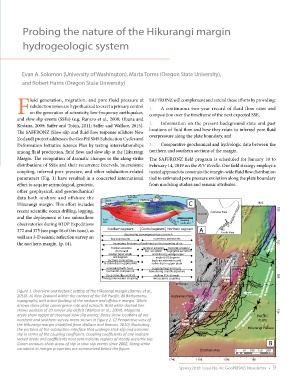
Probing the nature of the Hikurangi margin


           hydrogeologic system


          Evan A. Solomon (University of Washington), Marta Torres (Oregon State University),

          and Robert Harris (Oregon State University)


             luid generation, migration, and pore fluid pressure at  SAFFRONZ will complement and extend these efforts by providing:
             subduction zones are hypothesized to exert a primary control   1.   A continuous two-year record of fluid flow rates and
        Fon the generation of seismicity, low-frequency earthquakes,   composition over the timeframe of the next expected SSE,
        and slow slip events (SSEs) (e.g. Ranero et al., 2008; Obana and
        Kodaira, 2009; Saffer and Tobin, 2011; Saffer and Wallace, 2015).   2.   Information on the present background state and past
        The SAFFRONZ (Slow-slip and fluid flow response offshore New   locations of fluid flow and how they relate to inferred pore fluid
        Zealand) project addresses the GeoPRISMS Subduction Cycles and   overpressure along the plate boundary, and
        Deformation Initiative Science Plan by testing interrelationships  3.   Comparative geochemical and hydrologic data between the
        among fluid production, fluid flow, and slow slip at the Hikurangi   northern and southern sections of the margin.
        Margin. The recognition of dramatic changes in the along-strike  The SAFFRONZ field program is scheduled for January 10 to
        distributions of SSEs and their recurrence intervals, interseismic  February 14, 2019 on the R/V Revelle. Our field strategy employs a
        coupling, inferred pore pressure, and other subduction-related  nested approach to constrain the margin-wide fluid flow distribution
        parameters (Fig. 1) have resulted in a concerted international  tied to estimated pore pressure evolution along the plate boundary
        effort to acquire seismological, geodetic,             from modeling studies and seismic attributes.
        other geophysical, and geomechanical
        data both onshore and offshore the            Australian
                                             South    Plate  North Island      B .
        Hikurangi margin. This effort includes   Island         35 km           C                           180E
        recent scientific ocean drilling, logging,      12 km      50            60      Australian Plate             35S
                                                                                    Australia     Kermadec Tr. Tonga Tr.
                                                  6 km
        and the deployment of two subseafloor   22
                                            Pacic                      PAC/AUS  coupling
        observatories during IODP Expeditions   Plate  Hikurangi Trench  35  47  ~43 mm/yr 0  coecient  1  HT
        372 and 375 (see page 16 of this issue), as   Southern segment  Central segment Northern segment  A  NZ
                                                                                              Pacic Plate
                                                     decreasing convergence rate at trench
        well as a 3-D seismic reflection survey on   few seamounts  numerous seamounts
                                                                                                                 Sediment
        the northern margin. (p. 14).           increasing thickness of sediment on the incoming plate          Kermadec Trench  37S
                                                frontal accretion  tectonic erosion/  tectonic erosion/           starved
                                                 dominant     low  accretion  negligible accretion
                                              wedge taper angle  accretionary wedge taper
                                                4-6 degrees       angle 6-10 degrees
                                              tectonic contraction  back-arc extension and                    Ruatoria
                                                                                                PENINSULA
                                                                         B
                                             & strike-slip in upper plate  strike-slip in upper plate        avalanche
                                              emerging uids have    Seeps/springs in forearc   RAUKUMARA  Gisborne
                                             no mantle component  have strong  mantle signature
                                                                                                                & tectonic erosion
                                             deep slow slip events &  shallow SSEs & weak   TVZ                       39S
                                            strong interseismic coupling   interseismic coupling  Hawke
                                                                                   Mt Ruapehu  Bay
                                                                           Mt Taranaki            LR      Hikurangi Subducted seamounts
                                                                                          Napier  KR     Channel
        Figure 1. Overview and tectonic setting of the Hikurangi margin (Barnes et al.,   NIDFB
        2010). A) New Zealand within the context of the SW Pacific. B) Bathymetry,   Australian Plate   43 km/my
        topography, and active faulting of the onshore and offshore margin. White
        arrows show plate convergence rate and azimuth. Bold white dashed line
        shows position of 20 mm/yr slip deficit (Wallace et al., 2004). Magenta     WAIRARAPA                         41S
        areas show region of observed slow slip events. Boxes show locations of our              Trough      PACIFIC
                                                                                                      dominant
        northern and southern survey areas shown in Figure 2. C) Perspective view of   Cook         Frontal accretion  PLATE
                                                                               Wellington
        the Hikurangi margin (modified from Wallace and Beavan, 2010) illustrating   Strait  Hikurangi
        the portions of the subduction interface that undergo stick-slip and aseismic                    Hikurangi Plateau
                                                                                    Hikurangi
        slip in terms of the coupling coefficient. Coupling coefficients of one indicate   Channel
        locked areas and coefficients near zero indicate regions of steady aseismic slip.
        Green contours show areas of slip in slow slip events since 2002. Along strike                           B
        variations in margin properties are summarized below the figure.             Chatham Rise  0  50  100  150  200
                                                                                                                 km
                                                                        174E       176E       178E        180
                                                                            Spring 2018  Issue No. 40  GeoPRISMS Newsletter  •  9

