


Page 80 - MODULE QUALITY TOOLS DMQ 30262
P. 80
DMQ 30262


                 to the product or service. A CTQ usually must be interpreted from a qualitative customer
                 statement to an actionable, quantitative business specification


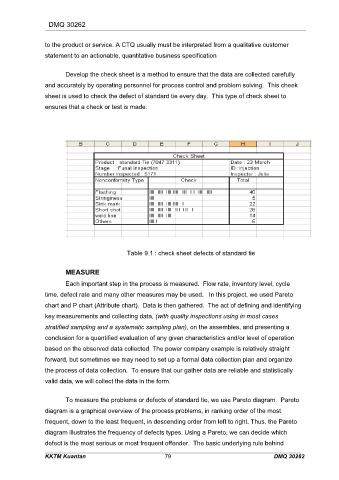
                        Develop the check sheet is a method to ensure that the data are collected carefully

                 and accurately by operating personnel for process control and problem solving. This cheek
                 sheet is used to check the defect of standard tie every day. This type of check sheet to
                 ensures that a check or test is made.


                                              Table 9.1 : check sheet defects of standard tie


                        MEASURE
                        Each important step in the process is measured. Flow rate, inventory level, cycle

                 time, defect rate and many other measures may be used. In this project, we used Pareto
                 chart and P chart (Attribute chart). Data is then gathered. The act of defining and identifying
                 key measurements and collecting data, (with quality inspections using in most cases

                 stratified sampling and a systematic sampling plan), on the assembles, and presenting a
                 conclusion for a quantified evaluation of any given characteristics and/or level of operation

                 based on the observed data collected. The power company example is relatively straight
                 forward, but sometimes we may need to set up a formal data collection plan and organize
                 the process of data collection. To ensure that our gather data are reliable and statistically

                 valid data, we will collect the data in the form.


                        To measure the problems or defects of standard tie, we use Pareto diagram. Pareto
                 diagram is a graphical overview of the process problems, in ranking order of the most
                 frequent, down to the least frequent, in descending order from left to right. Thus, the Pareto

                 diagram illustrates the frequency of defects types. Using a Pareto, we can decide which
                 defect is the most serious or most frequent offender. The basic underlying rule behind

                 KKTM Kuantan                              79                                    DMQ 30262

