


Page 100 - analysis-and-interpretation-of-astronomical-sp
P. 100
Analysis and Interpretation of Astronomical Spectra                                100

22.7 Line Emission by Collision Excitation

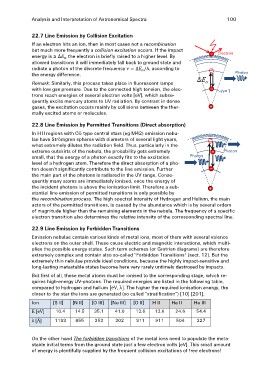
If an electron hits an ion, then in most cases not a recombination

but much more frequently a collision excitation occurs. If the impact              Electron
energy is ≥ the electron is briefly raised to a higher level. By

allowed transitions it will immediately fall back to ground state and
radiate a photon of the discrete frequency           , according to
the energy difference.                                                                                                                                                     Photon

Remark: Similarly, this process takes place in fluorescent lamps           ΔEn

with low gas pressure. Due to the connected high tension, the elec-                n=1
trons reach energies of several electron volts [eV], which subse-
quently excite mercury atoms to UV radiation. By contrast in dense
gases, the excitation occurs mainly by collisions between the ther-
mally excited atoms or molecules.
                                                                           Collision Excitation

22.8 Line Emission by Permitted Transitions (Direct absorption)

In H II regions with O5 type central stars (eg M42) emission nebu-
lae have Strömgren spheres with diameters of several light years,
what extremely dilutes the radiation field. Thus, particularly in the
extreme outskirts of the nebula, the probability gets extremely
                                                                           Photon  Photon

small, that the energy of a photon exactly fits to the excitation
level of a hydrogen atom. Therefore the direct absorption of a pho-
ton doesn’t significantly contribute to the line emission. Further
the main part of the photons is radiated in the UV range. Conse-
quently many atoms are immediately ionised, once the energy of
the incident photons is above the ionisation limit. Therefore a sub-
stantial line emission of permitted transitions is only possible by
tahcetorrescoofmtbhienpateiromnipttreodcetrsasn. sTihtieonhsig, hisscpaeucsteradlbinyttehnesiatybuonfdHayndcreogwehnicahndisDHbireyeliscuetmvAe,brtahsleoormrpdateiiornsn
of magnitude higher than the remaining elements in the nebula. The frequency of a specific
electron transition also determines the relative intensity of the corresponding spectral line.

22.9 Line Emission by Forbidden Transitions

Emission nebulae contain various kinds of metal ions, most of them with several valence
electrons on the outer shell. These cause electric and magnetic interactions, which multi-
plies the possible energy states. Such term schemes (or Grotrian diagrams) are therefore
extremely complex and contain also so-called "Forbidden Transitions" (sect. 12). But the
extremely thin nebulae provide ideal conditions, because the highly impact-sensitive and
long-lasting metastable states become here very rarely untimely destroyed by impacts.

But first of all, these metal atoms must be ionised to the corresponding stage, which re-
quires high-energy UV-photons. The required energies are listed in the following table,
compared to hydrogen and helium [eV, λ]. The higher the required ionisation energy, the
closer to the star the ions are generated (so called “stratification”) [10] [201].

Ion [S II] [N II] [O III] [Ne III] [O II] H II He II He III

E [eV]  10.4 14.5 35.1             41.0     13.6 13.6                24.6  54.4

λ [Å] 1193 855 353 302 911 911 504 227

On the other hand The forbidden transitions of the metal ions need to populate the meta-
stable initial terms from the ground state just a few electron volts [eV]. This small amount
of energy is plentifully supplied by the frequent collision excitations of free electrons!

