


Page 102 - analysis-and-interpretation-of-astronomical-sp
P. 102
Analysis and Interpretation of Astronomical Spectra 102
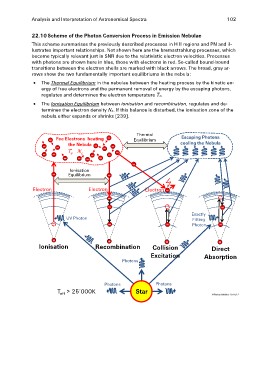
22.10 Scheme of the Photon Conversion Process in Emission Nebulae
This scheme summarises the previously described processes in H II regions and PN and il-
lustrates important relationships. Not shown here are the bremsstrahlung processes, which
become typically relevant just in SNR due to the relativistic electron velocities. Processes
with photons are shown here in blue, those with electrons in red. So-called bound-bound
transitions between the electron shells are marked with black arrows. The broad, gray ar-
rows show the two fundamentally important equilibriums in the nebula:
The Thermal Equilibrium in the nebulae between the heating process by the kinetic en-
ergy of free electrons and the permanent removal of energy by the escaping photons,
regulates and determines the electron temperature Te.
The Ionisation Equilibrium between ionisation and recombination, regulates and de-
termines the electron density Ne. If this balance is disturbed, the ionisation zone of the
Ionniesbaultaioenith-,erReexpcaonmdsboirnsahtriinokns-[2a3n9d]. Excitation Processes in Emission Nebulae
Fee Electrons heating Thermal Escaping Photons
the Nebula Equilibrium cooling the Nebula
Te Ne
Electron Ionisation Electron
Equilibrium
Electron
UV Photon Exactly
Fitting
Photon
Ionisation Recombination Collision Direct
Excitation Absorption
Photons
Photons Photons
Teff > 25‘000K Star ©Richard Walker 2011/12

