


Page 46 - analysis-and-interpretation-of-astronomical-sp
P. 46
Analysis and Interpretation of Astronomical Spectra  46

12 Forbidden Lines or –Transitions

Based on the already presented theories this phenomenon can just roughly be explained.
For a more comprehensive understanding, further quantum mechanical knowledge would
be required. For practical amateur spectroscopy, this is anyway not really necessary.

Most amateurs certainly have an [O III] filter for the contrast enhancement of emission
nebulae. It lets pass the wavelengths of the two green emission lines of the doubly ionised
oxygen [O III] at 4959Å and 5007Å. These lines are generated here by so-called "Forbidden
Transitions" between the energy levels (sect. 22). The initial levels of such transitions are
called “metastable”, because they are highly sensitive to impacts and an electron must re-
main her for a quite long time (several seconds to minutes) until it performs the forbidden
“jump”. These circumstances increase drastically the likelihood that this state is destroyed
before the forbidden transition happens.

"Forbidden" therefore means that in dense gases, such as on the earth's surface or in stel-
lar atmospheres, these transitions are extremely unlikely, because they are prevented by
frequent collisions with other particles. This disturbing effect occurs very rarely within the
extremely thin gases of the interstellar space. Thus such transitions are possible here. Such
forbidden lines are denoted within square brackets eg [O III], [N II], [Fe XIV].

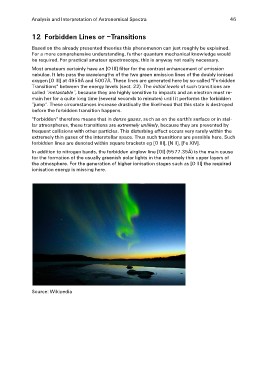
In addition to nitrogen bands, the forbidden airglow line [OI] (5577.35Å) is the main cause
for the formation of the usually greenish polar lights in the extremely thin upper layers of
the atmosphere. For the generation of higher ionisation stages such as [O III] the required
ionisation energy is missing here.

Source: Wikipedia

