


Page 50 - analysis-and-interpretation-of-astronomical-sp
P. 50
Analysis and Interpretation of Astronomical Spectra                             50

13.5 “Early” and “Late” Spectral Types

One of the faulty hypotheses on the long road to this classification system postulated that
the spectral sequence from O to M represents the chronological stages of a star. Unaware
at that time of nuclear fusion as a "sustainable" energy source, even the hypothesis was
discussed, that the stars could generate their energy only by contraction, ie starting very
hot and finally ending cool. This error has subsequently influenced the terminology until to-
day. Thus the O, B, A classes are called "early", the F and G classes "medium" and K and M
as "late" types. This systematic is also applied within a class. So M0 is called an “early” and
M8 a “late” M-type. Logically is for example M1 "earlier" than M7.

13.6 The MK (Morgan Keenan) or Yerkes System

Later on, the progress in nuclear physics and the increasing knowledge of the stellar evolu-
tion required a further adaptation and extension of the system. It was eg recognised, that
within the same spectral class, stars can show totally different absolute luminosities,
mainly caused by different stages of stellar development.1943, as another milestone, the
classification system was extended with an additional Roman numeral by Morgan, Keenan
and Kellmann from the Mt Wilson Observatory. This second dimension of the classification
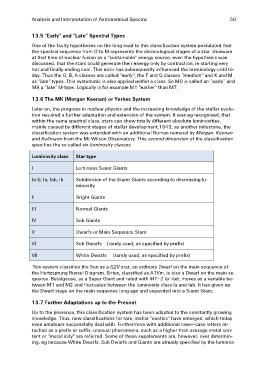
specifies the so called six luminosity classes.

Luminosity class Star type

I Luminous Super Giants

Ia-0, Ia, Iab, Ib  Subdivision of the Super Giants according to decreasing lu-
                   minosity

II Bright Giants

III Normal Giants

IV Sub Giants

V Dwarfs or Main Sequence Stars

VI Sub Dwarfs (rarely used, as specified by prefix)

VII White Dwarfs (rarely used, as specified by prefix)

This system classifies the Sun as a G2V star, an ordinary Dwarf on the main sequence of
the Hertzsprung Russel Diagram. Sirius, classified as A1Vm, is also a Dwarf on the main se-
quence. Betelgeuse, as a Super Giant and rated with M1–2 Ia–Iab, moves as a variable be-

tween M1 and M2 and fluctuates between the luminosity class Ia and Iab. It has given up
the Dwarf stage on the main sequence long ago and expanded into a Super Giant.

13.7 Further Adaptations up to the Present
Up to the presence, this classification system has been adapted to the constantly growing
knowledge. Thus, new classifications for rare, stellar "exotics" have emerged, which today
even amateurs successfully deal with. Furthermore with additional lower-case letters at-
tached as a prefix or suffix, unusual phenomena, such as a higher than average metal con-
tent or "metallicity" are referred. Some of these supplements are, however, over determin-
ing, eg because White Dwarfs, Sub Dwarfs and Giants are already specified by the luminos-

