


Page 51 - analysis-and-interpretation-of-astronomical-sp
P. 51
Analysis and Interpretation of Astronomical Spectra                                  51

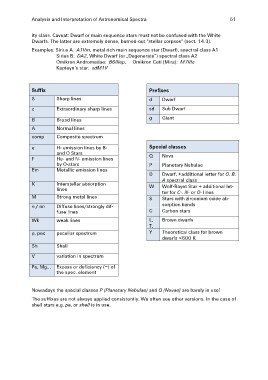
ity class. Caveat: Dwarf or main sequence stars must not be confused with the White
Dwarfs. The latter are extremely dense, burned-out "stellar corpses" (sect. 14.3).

Examples: Sirius A: A1Vm, metal rich main sequence star (Dwarf), spectral class A1
              Sirius B: DA2, White Dwarf (or „Degenerate“) spectral class A2
              Omikron Andromedae: B6IIIep, Omikron Ceti (Mira): M7IIIe
              Kapteyn‘s star: sdM1V

Suffix  Sharp lines                                  Prefixes
S       Extraordinary sharp lines                    d Dwarf
c                                                    sd Sub Dwarf
        Broad lines                                  g Giant
B       Normal lines
A       Composite spectrum                           Special classes
comp                                                 Q Nova
        H- emission lines by B-                      P Planetary Nebulae
e       and O Stars                                  D Dwarf, +additional letter for O, B,
        He- and N- emission lines
F       by O-stars                                          A spectral class
        Metallic emission lines                      W Wolf-Rayet Star + additional let-
Em
                                                            ter for C-, N- or O- lines
K       Interstellar absorption                      S Stars with zirconium oxide ab-
M       lines
n / nn  Strong metal lines                                  sorption bands
                                                     C Carbon stars
Wk      Diffuse lines/strongly dif-                  L, Brown dwarfs
        fuse lines                                   T,
        weak lines                                   Y Theoretical class for brown

p, pec peculiar spectrum                                    dwarfs <600 K

Sh Shell
V variation in spectrum
Fe, Mg… Excess or deficiency (–) of

               the spec. element

Nowadays the special classes P (Planetary Nebulae) and Q (Novae) are barely in use!
The suffixes are not always applied consistently. We often see other versions. In the case of
shell stars e.g. pe, or shell is in use.

