


Page 63 - analysis-and-interpretation-of-astronomical-sp
P. 63
Analysis and Interpretation of Astronomical Spectra 63
1. In the upper, red profile the spaceship moves away by the small amount from to
, during the transmission of one entire oscillation period. Therefore the end of the
emitted oscillation period covers this additional way to the observer with a corre-
spondingly extended runtime . therefore measures a red shift, ie an extension of
the rest wavelength by . Here, the sign of the radial velocity is positive .
2. In the middle, black profile, observer measures the originally transmitted oscillation
period with the so-called rest wavelength , because the radial velocity of the space
ship is here . ,
3. In the lower, blue profile the spaceship approaches by the small amount from to
. Therefore the end of the emitted oscillation period covers this shortened way to the
observer with a correspondingly reduced runtime . therefore measures a blue-
shift, ie a reduction of the rest wavelength by . Here, the sign of the radial veloc-
ity is negative .
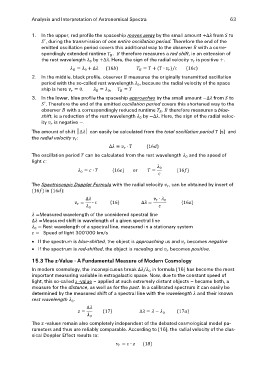
The amount of shift can easily be calculated from the total oscillation period [s] and
the radial velocity :
The oscillation period can be calculated from the rest wavelength and the speed of
light :
The Spectroscopic Doppler Formula with the radial velocity , can be obtained by insert of
in :
Measured wavelength of the considered spectral line
Measured shift in wavelength of a given spectral line
Rest wavelength of a spectral line, measured in a stationary system
Speed of light 300‘000 km/s
If the spectrum is blue-shifted, the object is approaching us and becomes negative
If the spectrum is red-shifted, the object is receding and becomes positive.
15.3 The z-Value - A Fundamental Measure of Modern Cosmology
In modern cosmology, the inconspicuous break in formula {16} has become the most
important measuring variable in extragalactic space. Now, due to the constant speed of
light, this so-called -value – applied at such extremely distant objects – became both, a
measure for the distance, as well as for the past. In a calibrated spectrum it can easily be
determined by the measured shift of a spectral line with the wavelength and their known
rest wavelength .
The -values remain also completely independent of the debated cosmological model pa-
rameters and thus are reliably comparable. According to {16}, the radial velocity of the clas-
sical Doppler Effect results to:

