


Page 58 - analysis-and-interpretation-of-astronomical-sp
P. 58
Analysis and Interpretation of Astronomical Spectra                                                                           58

14.2 The Absolute Magnitude and Photospheric Temperature of the Star
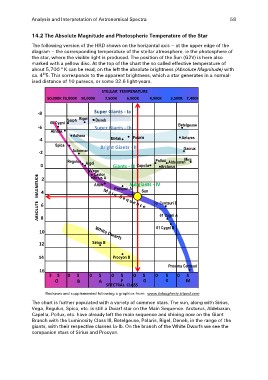
The following version of the HRD shows on the horizontal axis – at the upper edge of the
diagram – the corresponding temperature of the stellar atmosphere, ie the photosphere of
the star, where the visible light is produced. The position of the Sun (G2V) is here also
marked with a yellow disc. At the top of the chart the so called effective temperature of
about 5,700 ° K can be read, on the left the absolute brightness (Absolute Magnitude) with
ca. 4M5. This corresponds to the apparent brightness, which a star generates in a normal-
ised distance of 10 parsecs, or some 32.6 light-years.

                                                           STELLAR TEMPERATURE  3,500K 2,400K
                       50,000K 25,000K 10,000K 7,500K 6,000K 4,900K

-8 Super Giants - Ia
                       68 Cygni Saiph Rigel Deneb
                                                                                                                  Betelgeuse
-6 Alnitak                                     Super Giants - Ib                                                    Antares
                                                                                                                     Gacrux
-4                              Adhara             Mirfak         Polaris

                       Spica                    Bright Giants - II

-2                              Achernar

                    0           Regulus Algol      Giants - III Capella    Pollux AldebaranMira
                                                                              Arcturus
                                          Vega
                    2 SCiarisutsorA
ABSOLUTE MAGNITUDE
                                          Altair Subgiants - IV
                                                   Procyon A
                    4                                               Sun

                    6 α Centauri B

                    8 61 Cygni A

                                                                                                      61 Cygni B

                    10

12 Sirius B

14 Procyon B

                    16          05        05 05 05                                  Proxima Centauri
                         35          B
                             O                  AF                  G      0 5 05
                                                SPECTRAL CLASS                   KM

                       Redrawn and supplemented following a graphics from: www.bdaugherty.tripod.com

The chart is further populated with a variety of common stars. The sun, along with Sirius,
Vega, Regulus, Spica, etc. is still a Dwarf star on the Main Sequence. Arcturus, Aldebaran,
Capella, Pollux, etc. have already left the main sequence and shining now on the Giant
Branch with the Luminosity Class III, Betelgeuse, Polaris, Rigel, Deneb, in the range of the
giants, with their respective classes Ia-Ib. On the branch of the White Dwarfs we see the
companion stars of Sirius and Procyon.

