


Page 60 - analysis-and-interpretation-of-astronomical-sp
P. 60
Analysis and Interpretation of Astronomical Spectra               60

14.4 The Evolution of Massive Stars
In the next subsection it will be shown how the length of stay on the main sequence is
dramatically reduced with increasing stellar mass. Highly complex nuclear processes cause
complex pendulum like movements in the upper part of the HRD, showing various stages of
variables (more details see [33]). During this period also many of the heavy elements in the
periodic table are generated. Massive Stars about >8–10 solar masses, will not end as
White Dwarfs, but explode as Supernovae [2]. Depending on the mass of the star it finally
remains a Neutron Star, if the rest of the stellar mass is not greater than about 1.5–3 solar
masses (TOV limit: Tolman-Oppenheimer-Volkoff). Above this limit, eg stars with initial
>15–20 solar masses, will end in a Black Hole.

14.5 The Relation between Stellar Mass and Life Expectancy
The effect of the initial stellar mass is crucial for its further life. First, it decides which place
it occupies on the Main Sequence. The larger the mass the more left in the HRD or "earlier"
in respect of the spectral classification. Second, it has a dramatic impact on his entire life
expectancy, and the somewhat shorter period of time that he will spend on the Main Se-
quence. This ranges from roughly some million years for the early O- types up to >100 bil-
lion years for Red Dwarf stars of the M class. This is due to the fact that with increasing
mass the stars consume their "fuel" over proportionally faster. This relationship becomes
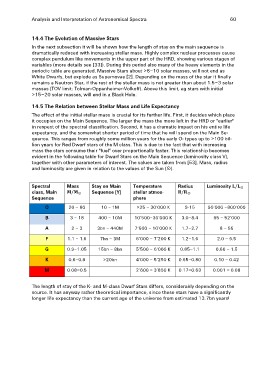
evident in the following table for Dwarf Stars on the Main Sequence (luminosity class V),
together with other parameters of interest. The values are taken from [53]. Mass, radius
and luminosity are given in relation to the values of the Sun ( ).

Spectral     Mass       Stay on Main  Temperature       Radius    Luminosity
class, Main             Sequence [Y]  stellar atmos-
Sequence                              phere                 9-15  90‘000 –800‘000
             20 – 60      10 – 1M
        O     3 – 18    400 – 10M       >25 – 30‘000 K
        B      2–3      3bn – 440M
        A    1.1 – 1.6   7bn – 3M     10‘500–30‘000 K 3.0–8.4     95 – 52‘000
        F    0.9–1.05   15bn – 8bn
        G    0.6–0.8                  7‘500 – 10‘000 K 1.7–2.7    8 – 55
        K    0.08–0.5       >20bn
       M                              6‘000 – 7‘200 K   1.2–1.6   2.0 – 6.5

                                      5‘500 – 6‘000 K 0.85–1.1    0.66 – 1.5

                                      4‘000 – 5‘250 K 0.65–0.80   0.10 – 0.42

                                      2‘600 – 3‘850 K 0.17–0.63   0.001 – 0.08

The length of stay of the K- and M-class Dwarf Stars differs, considerably depending on the
source. It has anyway rather theoretical importance, since these stars have a significantly
longer life expectancy than the current age of the universe from estimated 13.7bn years!

