


Page 61 - analysis-and-interpretation-of-astronomical-sp
P. 61
Analysis and Interpretation of Astronomical Spectra  61

14.6 Age Estimation of Star Clusters

The relationship between the spectral class and the according time, spent on the Main Se-
quence, allows the age estimation of star clusters – this under the assumption that such
clusters are formed within approximately the same period from a gas and dust cloud. If the
spectral classes of the cluster stars are transferred to the HRD, it gives the following inter-
esting picture: The older the cluster, the more right in the diagram (ie, "later") the distribu-
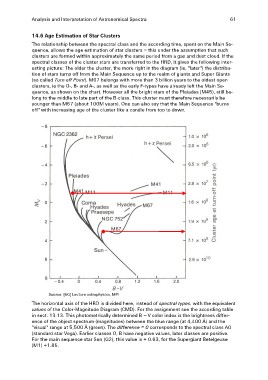
tion of stars turns off from the Main Sequence up to the realm of giants and Super Giants
(so called Turn off Point). M67 belongs with more than 3 billion years to the oldest open
clusters, ie the O-, B- and A-, as well as the early F-types have already left the Main Se-
quence, as shown on the chart. However all the bright stars of the Pleiades (M45), still be-

Alter eines Sternhaufenslong to the middle to late part of the B-class. This cluster must therefore necessarily be

younger than M67 (about 100M years). One can also say that the Main Sequence "burns
off" with increasing age of the cluster like a candle from top to down.

            Source: [50] Lecture astrophysics, MPI

The horizontal axis of the HRD is divided here, instead of spectral types, with the equivalent
values of the Color-Magnitude Diagram (CMD). For the assignment see the according table
in sect. 13.13. This photometrically determined B – V color index is the brightness differ-
ence of the object spectrum (magnitudes) between the blue range (at 4,400 Å) and the
"visual" range at 5,500 Å (green). The difference = 0 corresponds to the spectral class A0
(standard star Vega). Earlier classes O, B have negative values, later classes are positive.
For the main sequence star Sun (G2), this value is + 0.63, for the Supergiant Betelgeuse
(M1) +1.85.

