


Page 119 - spectroscopic-atlas-5_0-english_Neat
P. 119
Spectroscopic Atlas for Amateur Astronomers  119

26 Extragalactic Objects

26.1 Introduction

It’s impossible with amateur equipment, to record spectra of single stars within external
galaxies. However it’s feasible to record composite spectra of galaxies and Quasars! In con-
trast to profiles of individual stars the composite (or integrated) spectra show the super-
posed characteristics of hundreds of billions individual star spectra. Using Doppler spec-
troscopy thus also the radial velocities, respectively the z-values of such objects can be
measured. Further by "edge on" galaxies the rough distribution of the rotation speed within
the galactic disk can be estimated [30].

On a professional level, this has been practiced successfully since the beginning of the
20th century and has contributed substantially to our present understanding of the uni-
verse. The first, who tried this with M31, was Vesto M. Slipher in 1912 at the Lowell Ob-
servatory in Flagstaff Arizona. He was able to measure the blue shift of the spectrum and
derived a radial velocity of –300 km/s. Further he detected the rotation of this "nebula".
The fact that M31 is a galaxy outside the Milky Way was proved only later in the early
twenties. Further, he also noted that most of the other galaxies appear red shifted and thus
are removing from us. Lemaître and Hubble used these shift measurements later for the
correlation with the distance (Hubble constant).

26.2 Morphological Classification

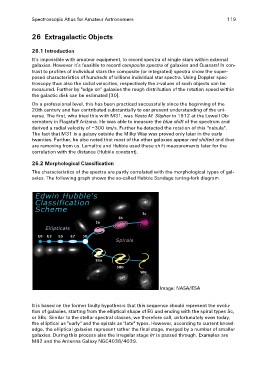
The characteristics of the spectra are partly correlated with the morphological types of gal-
axies. The following graph shows the so-called Hubble Sandage tuning-fork diagram.

                                                                              Image: NASA/ESA

It is based on the former faulty hypothesis that this sequence should represent the evolu-
tion of galaxies, starting from the elliptical shape of E0 and ending with the spiral types Sc,
or SBc. Similar to the stellar spectral classes, we therefore call, unfortunately even today,
the elliptical as "early" and the spirals as "late" types. However, according to current knowl-
edge, the elliptical galaxies represent rather the final stage, merged by a number of smaller
galaxies. During this process also the irregular stage Irr is passed through. Examples are
M82 and the Antenna Galaxy NGC4038/4039.

