


Page 129 - spectroscopic-atlas-5_0-english_Neat
P. 129
Spectroscopic Atlas for Amateur Astronomers 129
26.11 Blazars and BL Lacertae Objects (BL LAC's)
The Blazar Phenomenon
The term "Blazar" is composed of the terms "BL Lacertae" and "Quasar", used also abbrevi-
ated as "BL Lac". Allegedly the term was coined in 1978 by Ed Spiegel at a congress on BL
Lacertae objects in Pittsburgh, on the occasion of a banquet speech. Basically, these ob-
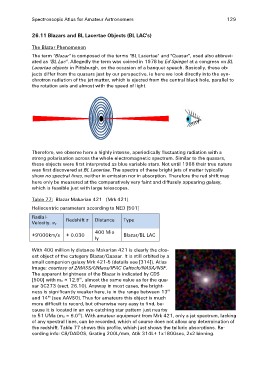
jects differ from the quasars just by our perspective, ie here we look directly into the syn-
chrotron radiation of the jet matter, which is ejected from the central black hole, parallel to
the rotation axis and almost with the speed of light.
Therefore, we observe here a highly intense, aperiodically fluctuating radiation with a
strong polarisation across the whole electromagnetic spectrum. Similar to the quasars,
these objects were first interpreted as blue variable stars. Not until 1968 their true nature
was first discovered at BL Lacertae. The spectra of these bright jets of matter typically
show no spectral lines, neither in emission nor in absorption. Therefore the red shift may
here only be measured at the comparatively very faint and diffusely appearing galaxy,
which is feasible just with large telescopes.
Table 77: Blazar Makarian 421 (Mrk 421)
Heliocentric parameters according to NED [501]
Radial- Redshift ݖDistance Type
Velocity. ݒ
+9'000km/s + 0.030 400 Mio Blazar/BL LAC
ly
With 400 million ly distance Makarian 421 is clearly the clos-
est object of the category Blazar/Quasar. It is still orbited by a
small companion galaxy Mrk 421-5 (details see [314]). Atlas
Image: courtesy of 2MASS/UMass/IPAC Caltech/NASA/NSF.
The apparent brightness of the Blazar is indicated by CDS
[500] with mV ≈ 12.9m, almost the same value as for the qua-
sar 3C273 (sect. 26.10). Anyway in most cases, the bright-
ness is significantly weaker here, ie in the range between 13m
and 14m (see AAVSO). Thus for amateurs this object is much
more difficult to record, but otherwise very easy to find, be-
cause it is located in an eye-catching star pattern just nearby
to 51 UMa (mV = 6.0m). With amateur equipment from Mrk 421, only a jet spectrum, lacking
of any spectral lines, can be recorded, which of course does not allow any determination of
the redshift. Table 77 shows this profile, which just shows the telluric absorptions. Re-
cording info: C8/DADOS, Grating 200L/mm, Atik 314L+ 1x1800sec, 2x2 binning.

