


Page 126 - spectroscopic-atlas-5_0-english_Neat
P. 126
Spectroscopic Atlas for Amateur Astronomers 126
26.10 Quasars
The Quasar Phenomenon
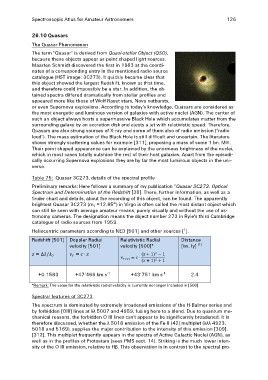
The term "Quasar" is derived from Quasi-stellar Object (QSO),
because these objects appear as point shaped light sources.
Maarten Schmidt discovered the first in 1963 at the coordi-
nates of a corresponding entry in the mentioned radio source
catalogue (HST image: 3C273). It quickly became clear that
this object showed the largest Redshift, known at that time,
and therefore could impossibly be a star. In addition, the ob-
tained spectra differed dramatically from stellar profiles and
appeared more like those of Wolf Rayet stars, Nova outbursts,
or even Supernova explosions. According to today's knowledge, Quasars are considered as
the most energetic and luminous version of galaxies with active nuclei (AGN). The center of
such an object always hosts a supermassive Black Hole which accumulates matter from the
surrounding galaxy by an accretion disk and ejects a jet with relativistic speed. Therefore,
Quasars are also strong sources of X-ray and some of them also of radio emission ("radio
loud"). The mass estimation of the Black Hole is still difficult and uncertain. The literature
shows strongly scattering values for example [311], proposing a mass of some 1 bn. M .
Their point shaped appearance can be explained by the enormous brightness of the nuclei,
which in most cases totally outshine the rest of their host galaxies. Apart from the episodi-
cally occurring Supernova explosions they are by far the most luminous objects in the uni-
verse.
Table 75: Quasar 3C273, details of the spectral profile
Preliminary remarks: Here follows a summary of my publication “Quasar 3C273, Optical
Spectrum and Determination of the Redshift [36]. There, further information, as well as a
finder chart and details, about the recording of this object, can be found. The apparently
brightest Quasar 3C273 (mV ≈12.85m) in Virgo is often called the most distant object which
can still be seen with average amateur means, purely visually and without the use of as-
tronomy cameras. The designation means the object number 273 in Ryle's third Cambridge
catalogue of radio sources from 1959.
Heliocentric parameters according to NED [501] and other sources [1].
Redshift [501] Doppler Radial Relativistic Radial Distance
ߣ∆ = ݖ/ߣ velocity [501] velocity [500]* [bn. ly] [1]
ݒ = ܿ ∙ ݖ ( ݖ+ 1)ଶ − 1
ݒ = ܿ ∙ ( ݖ+ 1)ଶ + 1
+0.1583 +47’469 km s-1 +43‘751 km s-1 2.4
*Remark: The value for the relativistic radial velocity is currently no longer included in [500]
Spectral features of 3C273
The spectrum is dominated by extremely broadened emissions of the H-Balmer series and
by forbidden [OIII] lines at λλ 5007 and 4959, fusing here to a blend. Due to quantum me-
chanical reasons, the forbidden O III lines can't appear to be significantly broadened. It is
therefore discussed, whether the λ 5018 emission of the Fe II (42) multiplet (λλλ 4923,
5018 and 5169), supplies the major contribution to the intensity of this emission [309],
[312]. This multiplet frequently appears in the spectra of Active Galactic Nuclei (AGN), as
well as in the profiles of Protostars (sees PMS sect. 14). Striking is the much lower inten-
sity of the O III emission, relative to Hβ. This observation is in contrast to the spectral pro-

