


Page 128 - spectroscopic-atlas-5_0-english_Neat
P. 128
Spectroscopic Atlas for Amateur Astronomers 128
mains fully independent of assumptions for cosmological model parameters (eg Ω). Due to
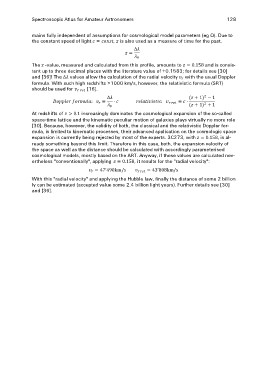
the constant speed of light ܿ = ܿݐݏ݊, ݖis also used as a measure of time for the past.
∆ߣ
ߣ = ݖ
The ݖ-value, measured and calculated from this profile, amounts to = ݖ0.158 and is consis-
tent up to three decimal places with the literature value of +0.1583; for details see [30]
and [36]! The ∆ߣ values allow the calculation of the radial velocity ݒ with the usual Doppler
formula. With such high redshifts >1000 km/s, however, the relativistic formula (SRT)
should be used for ݒ [16].
∆ߣ ( ݖ+ 1)ଶ − 1
݈ܽݑ݉ݎ݂ ݎ݈݁ܦ: ݒ = ߣ ∙ ܿ ܿ݅ݐݏ݅ݒ݅ݐ݈ܽ݁ݎ: ݒ = ܿ ∙ ( ݖ+ 1)ଶ + 1
At redshifts of > ݖ0.1 increasingly dominates the cosmological expansion of the so-called
space-time lattice and the kinematic peculiar motion of galaxies plays virtually no more role
[30]. Because, however, the validity of both, the classical and the relativistic Doppler for-
mula, is limited to kinematic processes, their advanced application on the cosmologic space
expansion is currently being rejected by most of the experts. 3C273, with = ݖ0.158, is al-
ready something beyond this limit. Therefore in this case, both, the expansion velocity of
the space as well as the distance should be calculated with accordingly parameterised
cosmological models, mostly based on the ART. Anyway, if these values are calculated nev-
ertheless "conventionally", applying = ݖ0.158, it results for the "radial velocity":
ݒ = 47‘490km/s ݒ = 43‘808km/s
With this "radial velocity" and applying the Hubble law, finally the distance of some 2 billion
ly can be estimated (accepted value some 2.4 billion light years). Further details see [30]
and [36].

