


Page 124 - spectroscopic-atlas-5_0-english_Neat
P. 124
Spectroscopic Atlas for Amateur Astronomers 124
The apparent chaotic structure of this galaxy can be at-
tributed to gravitational interaction with the much larger
neighbouring galaxy M81, as well as effects of the spe-
cific perspective (Image: HST). M82 is a typical represen-
tative of the starburst galaxies with very few weak ab-
sorption lines. Na I is here most likely of interstellar ori-
gin, mainly within M82. Additional features include in-
tense emissions of the H-Balmer series and probably
shock wave induced sulphur lines. The forbidden [OIII]
lines are here barely recognisable. Also striking is here
the double peak in the range of the Hγ-emission (compare also Seyfert galaxy M77, Table
73). Compared with galactic emission nebulae (sect. 28) as well as M77, the excitation
level is very low here. The forbidden [OIII] line at λ 5007 shows here up just very weakly
and the Hα emission is much more intense compared to [N II] at λ 6583. Recording info:
C8/DADOS/Atik 314L+: 1x1800sec, 2x2 binning mode.
M82 is also the host galaxy of the brightest supernova since decades, SN2014j, type Ia
(see sect. 25, Table 67).
26.8 The phenomenon of AGN (Active Galactic Nuclei)
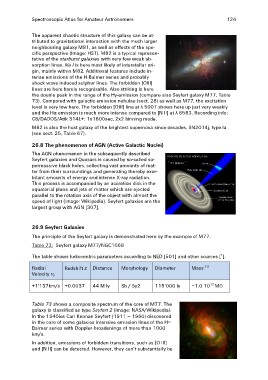
The AGN phenomenon in the subsequently described
Seyfert galaxies and Quasars is caused by so-called su-
permassive black holes, collecting vast amounts of mat-
ter from their surroundings and generating thereby exor-
bitant amounts of energy and intense X-ray radiation.
This process is accompanied by an accretion disk in the
equatorial plane and jets of matter which are ejected
parallel to the rotation axis of the object with almost the
speed of light (image: Wikipedia). Seyfert galaxies are the
largest group with AGN [307].
26.9 Seyfert Galaxies
The principle of the Seyfert galaxy is demonstrated here by the example of M77.
Table 73: Seyfert galaxy M77/NGC1068
The table shows heliocentric parameters according to NED [501] and other sources [1].
Radial Redshift ݖDistance Morphology Diameter Mass [1]
Velocity ݒ
+1'137km/s +0.0037 44 M ly Sb / Sy2 115‘000 ly ~1.0 1012 M
Table 73 shows a composite spectrum of the core of M77. The
galaxy is classified as type Seyfert 2 (image: NASA/Wikipedia).
In the 1940ies Carl Kennan Seyfert (1911 – 1960) discovered
in the core of some galaxies intensive emission lines of the H–
Balmer series with Doppler-broadenings of more than 1000
km/s.
In addition, emissions of forbidden transitions, such as [O III]
and [N II] can be detected. However, they can’t substantially be

