


Page 156 - spectroscopic-atlas-5_0-english_Neat
P. 156
Spectroscopic Atlas for Amateur Astronomers 156
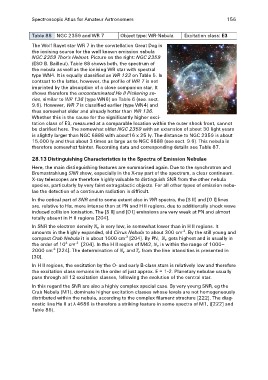
Table 88 NGC 2359 and WR 7 Object type: WR-Nebula Excitation class: E3
The Wolf Rayet star WR 7 in the constellation Great Dog is
the ionising source for the well known emission nebula
NGC 2359 Thor's Helmet. Picture on the right: NGC 2359
(ESO B. Bailleul). Table 88 shows both, the spectrum of
the nebula as well as the ionising WR star with spectral
type WN4. It is equally classified as WR 133 on Table 5. In
contrast to the latter, however, the profile of WR 7 is not
imprinted by the absorption of a close companion star. It
shows therefore the uncontaminated He II Pickering se-
ries, similar to WR 136 (type WN6) on Table 6 (see. sect.
9.6). However, WR 7 is classified earlier (type WN4) and
thus somewhat older and already hotter than WR 136.
Whether this is the cause for the significantly higher exci-
tation class of E3, measured at a comparable location within the outer shock front, cannot
be clarified here. The somewhat older NGC 2359 with an extension of about 30 light years
is slightly larger than NGC 6888 with about16 x 25 ly. The distance to NGC 2359 is about
15,000 ly and thus about 3 times as large as to NGC 6888 (see sect. 9.6). This nebula is
therefore somewhat fainter. Recording data and corresponding details see Table 87.
28.13 Distinguishing Characteristics in the Spectra of Emission Nebulae
Here, the main distinguishing features are summarised again. Due to the synchrotron and
Bremsstrahlung SNR show, especially in the X-ray part of the spectrum, a clear continuum.
X-ray telescopes are therefore highly valuable to distinguish SNR from the other nebula
species, particularly by very faint extragalactic objects. For all other types of emission nebu-
lae the detection of a continuum radiation is difficult.
In the optical part of SNR and to some extent also in WR spectra, the [S II] and [O I] lines
are, relative to Hα, more intense than at PN and H II regions, due to additionally shock wave
induced collision ionisation. The [S II] and [O I] emissions are very weak at PN and almost
totally absent in H II regions [204].
In SNR the electron density ܰ is very low, ie somewhat lower than in H II regions. It
amounts in the highly expanded, old Cirrus Nebula to about 300 cm-3. By the still young and
compact Crab Nebula it is about 1000 cm-3 [204]. By PN, ܰ gets highest and is usually in
the order of 104 cm-3 [204]. In the H II region of M42, ܰ is within the range of 1000–
2000 cm-3 [224]. The determination of ܰ and ܶ from the line intensities is presented in
[30].
In H II regions, the excitation by the O- and early B-class stars is relatively low and therefore
the excitation class remains in the order of just approx. E = 1-2. Planetary nebulae usually
pass through all 12 excitation classes, following the evolution of the central star.
In this regard the SNR are also a highly complex special case. By very young SNR, eg the
Crab Nebula (M1), dominate higher excitation classes whose levels are not homogeneously
distributed within the nebula, according to the complex filament structure [222]. The diag-
nostic line He II at λ 4686 is therefore a striking feature in some spectra of M1, ([222] and
Table 86).

