


Page 152 - spectroscopic-atlas-5_0-english_Neat
P. 152
Spectroscopic Atlas for Amateur Astronomers 152
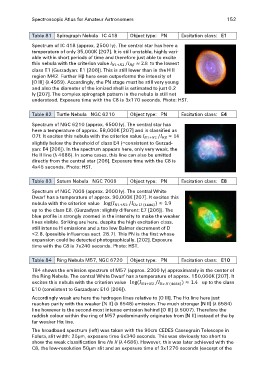
Table 81 Spirograph Nebula IC 418 Object type: PN Excitation class: E1
Spectrum of IC 418 (approx. 2500 ly). The central star has here a
temperature of only 35,000K [207]. It is still unstable, highly vari-
able within short periods of time and therefore just able to excite
this nebula with the criterion value ܫேଵାேଶ /ܫுఉ ≈ 2.8 to the lowest
class E1 (Gurzadyan: E1 [206]). This is still lower than in the H II
region M42. Further Hβ here even outperforms the intensity of
[O III] (λ 4959). Accordingly, the PN stage must be still very young
and also the diameter of the ionized shell is estimated to just 0.2
ly [207]. The complex spirograph pattern in the nebula is still not
understood. Exposure time with the C8 is 3x170 seconds. Photo: HST.
Table 82 Turtle Nebula NGC 6210 Object type: PN Excitation class: E4
Spectrum of NGC 6210 (approx. 6500 ly). The central star has
here a temperature of approx. 58,000K [207] and is classified as
O7f. It excites this nebula with the criterion value ܫேଵାேଶ /ܫுఉ ≈ 14
slightly below the threshold of class E4 (~consistent to Gurzad-
yan: E4 [206]). In the spectrum appears here, only very weak, the
He II line (λ 4686). In some cases, this line can also be emitted
directly from the central star [206]. Exposure time with the C8 is
4x45 seconds. Photo: HST.
Table 83 Saturn Nebula NGC 7009 Object type: PN Excitation class: E8
Spectrum of NGC 7009 (approx. 2000 ly). The central White
Dwarf has a temperature of approx. 90,000K [207]. It excites this
nebula with the criterion value log(ܫேଵାேଶ /ܫு ூூ (ସ଼)) ≈ 1.9
up to the class E8. (Gurzadyan: slightly different: E7 [206]). The
blue profile is strongly zoomed in the intensity to make the weaker
lines visible. Striking are here, despite the high excitation class,
still intense H emissions and a too low Balmer decrement of D
<2.8, (possible influences sect. 28.7). This PN is the first whose
expansion could be detected photographically. [202]. Exposure
time with the C8 is 7x240 seconds. Photo: HST.
Table 84 Ring Nebula M57, NGC 6720 Object type: PN Excitation class: E10
T84 shows the emission spectrum of M57 (approx. 2300 ly) approximately in the center of
the Ring Nebula. The central White Dwarf has a temperature of approx. 150,000K [207]. It
excites this nebula with the criterion value log(ܫேଵାேଶ /ܫு ூூ (ସ଼)) ≈ 1.4 up to the class
E10 (consistent to Gurzadyan: E10 [206]).
Accordingly weak are here the hydrogen lines relative to [O III]. The Hα line here just
reaches parity with the weaker [N II] (λ 6548) emission. The much stronger [N II] (λ 6584)
line however is the second-most intense emission behind [O III] (λ 5007). Therefore the
reddish colour within the ring of M57 predominantly originates from [N II] instead of the by
far weaker Hα line.
The broadband spectrum (left) was taken with the 90cm CEDES Cassegrain Telescope in
Falera, slit width: 25μm, exposure time 5x340 seconds. This was obviously too short to
show the weak classification line He II (λ 4686). However, this was later achieved with the
C8, the low-resolution 50μm slit and an exposure time of 3x1270 seconds (excerpt of the

