


Page 155 - spectroscopic-atlas-5_0-english_Neat
P. 155
Spectroscopic Atlas for Amateur Astronomers                                  155

Table 87 NGC 6888 Crescent Nebula Object type: WR-Nebula Excitation class: E1

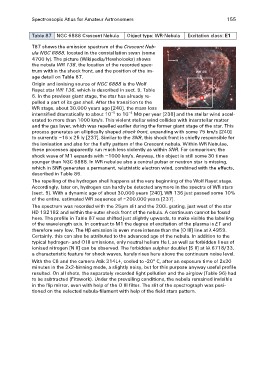
T87 shows the emission spectrum of the Crescent Neb-      N
ula NGC 6888, located in the constellation swan (some              W
4700 ly). The picture (Wikipedia/Hewholooks) shows
the nebula WR 136, the location of the recorded spec-                 WR136
trum within the shock front, and the position of the im-
age detail on Table 87.

Origin and ionising source of NGC 6888 is the Wolf
Rayet star WR 136, which is described in sect. 9, Table
6. In the previous giant stage, the star has already re-
pelled a part of its gas shell. After the transition to the
WR stage, about 30,000 years ago [240], the mass loss
intensified dramatically to about 10−5 to 10−4 M per year [236] and the stellar wind accel-
erated to more than 1000 km/s. This violent stellar wind collides with interstellar matter
and the gas layer, which was repelled earlier during the former giant stage of the star. This
process generates an elliptically shaped shock front, expanding with some 75 km/s [240]
to currently ~16 x 25 ly [237]. Similar to the SNR, this shock front is chiefly responsible for

the ionisation and also for the fluffy pattern of the Crescent nebula. Within WR Nebulae,
these processes apparently run much less violently as within SNR. For comparison; the

shock wave of M1 expands with ~1000 km/s. Anyway, this object is still some 30 times
younger than NGC 6888. In WR nebulae also a central pulsar or neutron star is missing,
which in SNR generates a permanent, relativistic electron wind, combined with the effects,
described in Table 86.

The repelling of the hydrogen shell happens at the very beginning of the Wolf Rayet stage.
Accordingly, later on, hydrogen can hardly be detected anymore in the spectra of WR stars
(sect. 9). With a dynamic age of about 30,000 years [240], WR 136 just passed some 10%
of the entire, estimated WR sequence of ~200,000 years [237].

The spectrum was recorded with the 25μm slit and the 200L grating, just west of the star
HD 192182 and within the outer shock front of the nebula. A continuum cannot be found
here. The profile in Table 87 was shifted just slightly upwards, to make visible the labelling
of the wavelength axis. In contrast to M1 the degree of excitation of the plasma is E1 and

therefore very low. The Hβ emission is even more intense than the [O III] line at λ 4959.
Certainly, this can also be attributed to the advanced age of the nebula. In addition to the
typical hydrogen- and O III emissions, only neutral helium He I, as well as forbidden lines of
ionised nitrogen [N II] can be observed. The forbidden sulphur doublet [S II] at λλ 6718/33,
a characteristic feature for shock waves, barely rises here above the continuum noise level.

With the C8 and the camera Atik 314L+, cooled to -20° C, after an exposure time of 2x30
minutes in the 2x2-binning mode, a slightly noisy, but for this purpose anyway useful profile
resulted. On all shots, the separately recorded light pollution and the airglow (Table 96) had
to be subtracted (Fitswork). Under the prevailing conditions, the nebula remained invisible
in the flip mirror, even with help of the O III filter. The slit of the spectrograph was posi-
tioned on the selected nebula-filament with help of the field stars pattern.

