


Page 53 - spectroscopic-atlas-5_0-english_Neat
P. 53
Spectroscopic Atlas for Amateur Astronomers                                          53

kind of double peak emission. A similar structure within this wavelength domain was com-
mented in [702] by H.A. Abt as a "Disk Line".

12.4 Classification System for Be Stars

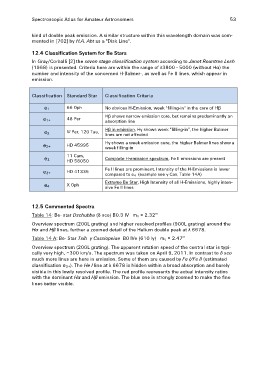
In Gray/Corballi [2] the seven stage classification system according to Janet Rountree Lesh
(1968) is presented. Criteria here are within the range of λ3800 - 5000 (without Hα) the
number and intensity of the concerned H-Balmer-, as well as Fe II lines, which appear in
emission.

Classification Standard Star Classification Criteria

e1 66 Oph             No obvious H-Emission, week "filling-in" in the core of Hβ

e1+ 48 Per            Hβ shows narrow emission core, but remains predominantly an
                      absorption line

e2   Ψ Per, 120 Tau,  Hβ in emission, Hγ shows week "filling-in", the higher Balmer
                      lines are not affected

e2+  HD 45995         Hγ shows a week emission core, the higher Balmer lines show a
                      week filling-in

e3   11 Cam,          Complete H-emission spectrum, Fe II emissions are present
     HD 58050

e3+  HD 41335         Fe II lines are prominent, Intensity of the H-Emissions is lower
                      compared to e4 (example see γ Cas, Table 14A)

e4 Χ Oph              Extreme Be Star, High Intensity of all H-Emissions, highly inten-
                      sive Fe II lines

12.5 Commented Spectra

Table 14: Be- star Dschubba (δ sco) B0.3 IV mV = 2.32m

Overview spectrum (200L grating) and higher resolved profiles (900L grating) around the
Hα and Hβ lines, further a zoomed detail of the Helium double peak at λ 6678.

Table 14 A: Be- Star Tsih γ Cassiopeiae B0 IVe (610 ly) mV = 2.47m

Overview spectrum (200L grating). The apparent rotation speed of the central star is typi-
cally very high, ~300 km/s. The spectrum was taken on April 9, 2011. In contrast to δ sco
much more lines are here in emission. Some of them are caused by Fe I/Fe II (estimated

classification e3+). The He I line at λ 6678 is hidden within a broad absorption and barely

visible in this lowly resolved profile. The red profile represents the actual intensity ratios
with the dominant Hα and Hβ emission. The blue one is strongly zoomed to make the fine
lines better visible.

