


Page 29 - Super Earth Encyclopedia
P. 29
CALDERAS

                                                                           A volcano that does not erupt for centuries often has a
                                                                           blocked crater. It builds up pressure below the blockage until
                                                                           it blows it into the sky in a massive eruption. This empties the
                                                                           magma chamber inside the volcano, so its unsupported peak
                                                                           collapses into the empty space. The result is a broad caldera
                                                                           that is much wider than the original crater.


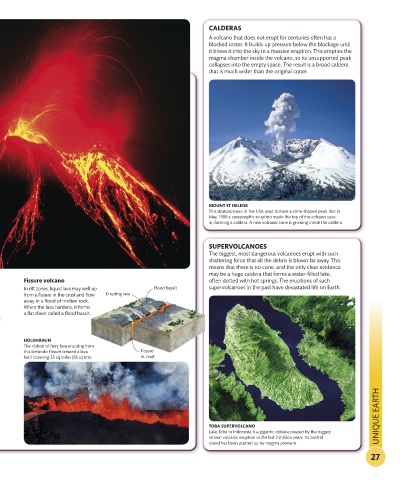
                                                                           MOUNT ST HELENS
                                                                           This stratovolcano in the USA used to have a cone-shaped peak. But in
                                                                           May 1980 a catastrophic eruption made the top of the volcano cave
                                                                           in, forming a caldera. A new volcanic cone is growing inside the caldera.


                                                                           SUPERVOLCANOES
                                                                           The biggest, most dangerous volcanoes erupt with such
                                                                           shattering force that all the debris is blown far away. This
                                                                           means that there is no cone, and the only clear evidence
                                                                           may be a huge caldera that forms a water-filled lake,
          Fissure volcano                                                  often dotted with hot springs. The eruptions of such
          In rift zones, liquid lava may well up        Flood basalt       supervolcanoes in the past have devastated life on Earth.
          from a fissure in the crust and flow   Erupting lava
          away in a flood of molten rock.
          When the lava hardens, it forms
          a flat sheet called a flood basalt.


          HOLUHRAUN
          The ribbon of fiery lava erupting from
          this Icelandic fissure created a lava    Fissure
          field covering 33 sq miles (85 sq km).   in crust


                                                                                                                                        UNIQUE EARTH


                                                                           TOBA SUPERVOLCANO
                                                                           Lake Toba in Indonesia is a gigantic caldera created by the biggest
                                                                           known volcanic eruption in the last 2 million years. Its central
                                                                           island has been pushed up by magma pressure.
                                                                                                                                     27


   US_026-027_Volcanoes.indd   27                                                                                                   01/03/17   11:21 am

