


Page 10 - DINOSOUR ATLAS
P. 10
dinosaur atlas
         Rise of the Reptiles


         Complex, multiCellular life evolved in the oceans, some 3 billion years after
         the appearance of the first bacteria. Invertebrates resembling modern sea
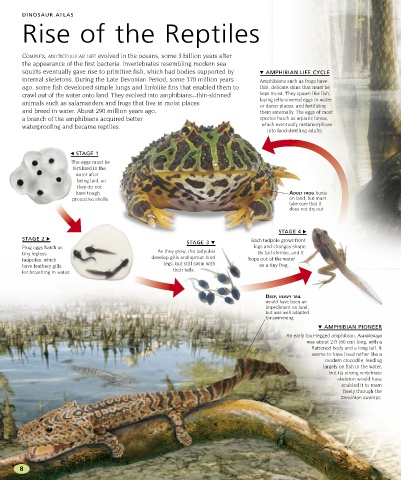
         squirts eventually gave rise to primitive fish, which had bodies supported by        d amphibian life cycle
         internal skeletons. During the Late Devonian Period, some 370 million years          Amphibians such as frogs have
         ago, some fish developed simple lungs and limblike fins that enabled them to         thin, delicate skins that must be
         crawl out of the water onto land. They evolved into amphibians—thin-skinned          kept moist. They spawn like fish,
         animals such as salamanders and frogs that live in moist places                      laying jelly-covered eggs in water
                                                                                              or damp places, and fertilizing
         and breed in water. About 290 million years ago,                                     them externally. The eggs of most
         a branch of the amphibians acquired better                                           species hatch as aquatic larvae,
         waterproofing and became reptiles.                                                   which eventually metamorphose
                                                                                                into land-dwelling adults.


                          , stage 1
                           The eggs must be
                           fertilized in the
                            water after
                            being laid, so
                            they do not
                            have tough                                                                  Adult frog hunts
                           protective shells.                                                           on land, but must
                                                                                                        take care that it
                                                                                                        does not dry out


                                                                                                    stage 4 .
         stage 2 .                                                                        Each tadpole grows front
                                                                    stage 3 d
         Frog eggs hatch as                                                                legs and changes shape.
         tiny legless                                    As they grow, the tadpoles          Its tail shrinks, and it
         tadpoles, which                               develop gills and sprout hind     hops out of the water
         have feathery gills                               legs, but still swim with         as a tiny frog.
         for breathing in water.                               their tails.


                                                                                                deep, heAvy tAil
                                                                                                would have been an
                                                                                                impediment on land,
                                                                                                but was well adapted
                                                                                                for swimming
                                                                                                                  d amphibian pioneer
                                                                                                       An early four-legged amphibian, Acanthostega
                                                                                                              was about 2 ft (60 cm) long, with a
                                                                                                                flattened body and a long tail. It
                                                                                                                seems to have lived rather like a
                                                                                                                     modern crocodile, feeding
                                                                                                                    largely on fish in the water,
                                                                                                                      but its strong vertebrate
                                                                                                                         skeleton would have
                                                                                                                           enabled it to roam
                                                                                                                           freely through the
                                                                                                                           Devonian swamps.

