


Page 9 - DINOSOUR ATLAS
P. 9
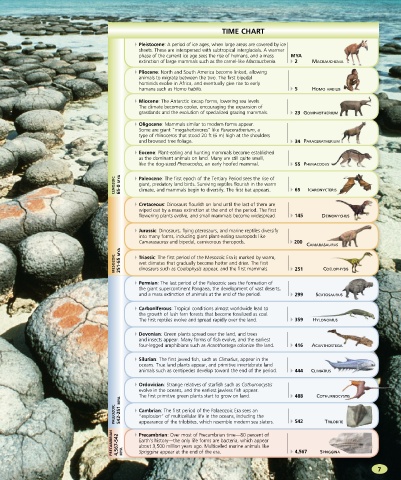
time chart

                                                 . Pleistocene: A period of ice ages, when large areas are covered by ice
                                                   sheets. These are interspersed with subtropical interglacials. A warmer
                                                   phase of the current ice age sees the rise of humans, and a mass   mYa
                                                   extinction of large mammals such as the camel-like Macrauchenia.   . 2   Macrauchenia
                                                 . Pliocene: North and South America become linked, allowing
                                                   animals to migrate between the two. The first bipedal
                                                   hominids evolve in Africa, and eventually give rise to early
                                                   humans such as Homo habilis.                          . 5    hoMo habilis

                                                 . miocene: The Antarctic icecap forms, lowering sea levels.
                                                   The climate becomes cooler, encouraging the expansion of
                                                   grasslands and the evolution of specialized grazing mammals.  . 23 GoMphotheriuM

                                                 . Oligocene: Mammals similar to modern forms appear.
                                                   Some are giant “megaherbivores” like Paraceratherium, a
                                                   type of rhinoceros that stood 20 ft (6 m) high at the shoulders
                                                   and browsed tree foliage.                             . 34 paraceratheriuM
                                                 . eocene: Plant-eating and hunting mammals become established
                                                   as the dominant animals on land. Many are still quite small,
                                                   like the dog-sized Phenacodus, an early hoofed mammal.  . 55 phenacodus

                                          cenozoic  65-0 mya  . Paleocene: The first epoch of the Tertiary Period sees the rise of   .  5  icaronycteris
                                                   giant, predatory land birds. Surviving reptiles flourish in the warm
                                                   climate, and mammals begin to diversify. The first bat appears.

                                                 . cretaceous: Dinosaurs flourish on land until the last of them are
                                                   wiped out by a mass extinction at the end of the period. The first
                                                   flowering plants evolve, and small mammals become widespread.  . 145  deinonychus


                                                 . Jurassic: Dinosaurs, flying pterosaurs, and marine reptiles diversify
                                                   into many forms, including giant plant-eating sauropods like
                                                   Camarasaurus and bipedal, carnivorous theropods.      . 200
                                                                                                              caMarasaurus
                                          mesozoic  251-65 mya  . triassic: The first period of the Mesozoic Era is marked by warm,   . 251  coelophysis
                                                   wet climates that gradually become hotter and drier. The first
                                                   dinosaurs such as Coelophysis appear, and the first mammals.

                                                 . Permian: The last period of the Paleozoic sees the formation of
                                                   the giant supercontinent Pangaea, the development of vast deserts,
                                                   and a mass extinction of animals at the end of the period.  . 299  scutosaurus

                                                 . carboniferous: Tropical conditions almost worldwide lead to
                                                   the growth of lush fern forests that become fossilized as coal.
                                                   The first reptiles evolve and spread rapidly over the land.  . 359  hylonoMus


                                                 . Devonian: Green plants spread over the land, and trees
                                                   and insects appear. Many forms of fish evolve, and the earliest
                                                   four-legged amphibians such as Acanthostega colonize the land.  . 41   acanthosteGa

                                                 . Silurian: The first jawed fish, such as Climatius, appear in the
                                                   oceans. True land plants appear, and primitive invertebrate land
                                                   animals such as centipedes develop toward the end of the period.   . 444  cliMatius

                                                 . Ordovician: Strange relatives of starfish such as Cothurnocystis
                                                   evolve in the oceans, and the earliest jawless fish appear.
                                                   The first primitive green plants start to grow on land.  . 488  cothurnocystis

                                          paleozoic  542-251 mya  . cambrian: The first period of the Palaeozoic Era sees an   . 542  trilobite
                                                   “explosion” of multicellular life in the oceans, including the
                                                   appearance of the trilobites, which resemble modern sea slaters.

                                         precambrian  4,567-542  . Precambrian: Over most of Precambrian time—80 percent of
                                                   Earth’s history—the only life forms are bacteria, which appear
                                                   about 3,500 million years ago. Multicelled marine animals like
                                             mya
                                                                                                                   spriGGina
                                                   Spriggina appear at the end of the era.
                                                                                                         . 4,5

