


Page 12 - DINOSOUR ATLAS
P. 12
dinosaur atlas
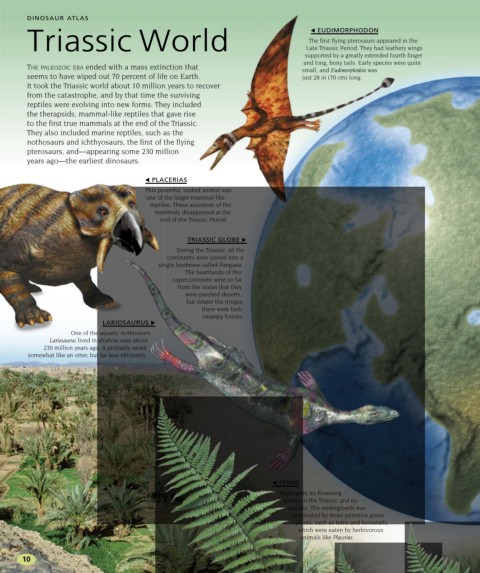
         Triassic World                                                                      The first flying pterosaurs appeared in the
                                                                                              , EudiMorPHodon

                                                                                            Late Triassic Period. They had leathery wings
                                                                                            supported by a greatly extended fourth finger
                                                                                           and long, bony tails. Early species were quite
         The paleozoic era ended with a mass extinction that                               small, and Eudimorphodon was
         seems to have wiped out 70 percent of life on Earth.                              just 28 in (70 cm) long.
         It took the Triassic world about 10 million years to recover
         from the catastrophe, and by that time the surviving
         reptiles were evolving into new forms. They included
         the therapsids, mammal-like reptiles that gave rise
         to the first true mammals at the end of the Triassic.
         They also included marine reptiles, such as the
         nothosaurs and ichthyosaurs, the first of the flying
         pterosaurs, and—appearing some 230 million
         years ago—the earliest dinosaurs.


                                            , PlaCErias
                                            This powerful, tusked animal was
                                            one of the larger mammal-like
                                              reptiles. These ancestors of the
                                               mammals disappeared at the
                                                 end of the Triassic Period.


                                                         triassiC GloBE .
                                                      During the Triassic, all the
                                                   continents were joined into a
                                                single landmass called Pangaea.
                                                        The heartlands of this
                                                    supercontinent were so far
                                                      from the ocean that they
                                                        were parched deserts,
                                                        but nearer the fringes
                                                             there were lush,
                                                             swampy forests.
                               lariosaurus .
                      One of the aquatic nothosaurs,
                Lariosaurus lived in shallow seas about
              230 million years ago. It probably swam
         somewhat like an otter, but far less efficiently.


                                                                                  , fErns
                                                                                    There were no flowering
                                                                                      plants in the Triassic and no
                                                                                       grasses. The undergrowth was
                                                                                        dominated by more primitive green
                                                                                         plants, such as ferns and horsetails,
                                                                                          which were eaten by herbivorous
                                                                                          animals like Placerias.

       10

