


Page 11 - DINOSOUR ATLAS
P. 11
rise of the reptiles


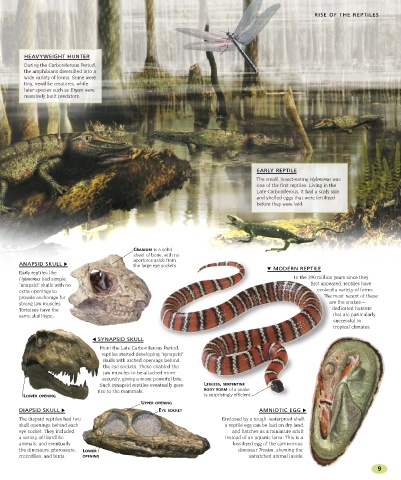
          heavyweight hunter
          During the Carboniferous Period,
          the amphibians diversified into a
          wide variety of forms. Some were
          tiny, newtlike creatures, while
          later species such as Eryops were
          massively built predators.


                                                                                            early reptile
                                                                                            The small, insect-eating Hylonomus was
                                                                                            one of the first reptiles. Living in the
                                                                                            Late Carboniferous, it had a scaly skin
                                                                                            and shelled eggs that were fertilized
                                                                                            before they were laid.


                                                 CrAnium is a solid
                                                 sheet of bone, with no
                                                 apertures aside from
        anapsid skull .                          the large eye sockets                          d modern reptile
        Early reptiles like
        Hylonomus had simple                                                                              In the 290 million years since they
        “anapsid” skulls with no                                                                                first appeared, reptiles have
        extra openings to                                                                                         evolved a variety of forms.
        provide anchorage for                                                                                       The most recent of these
        strong jaw muscles.                                                                                           are the snakes—
        Tortoises have the                                                                                             dedicated hunters
        same skull type.                                                                                                that are particularly
                                                                                                                        successful in
                                                                                                                        tropical climates.

                                  , synapsid skull
                                     From the Late Carboniferous Period,
                                     reptiles started developing “synapsid”
                                      skulls with arched openings behind
                                      the eye sockets. These enabled the
                                      jaw muscles to be attached more
                                     securely, giving a more powerful bite.
                                     Such synapsid reptiles eventually gave   legless, serpentine
                                    rise to the mammals.                  body form of a snake
         lower opening                                                    is surprisingly efficient
                                                   upper opening
        diapsid skull .                                   eye soCket                         amniotic egg .
        The diapsid reptiles had two                                            Enclosed by a tough, waterproof shell,
        skull openings behind each                                               a reptile egg can be laid on dry land,
        eye socket. They included                                                   and hatches as a miniature adult
        a variety of lizardlike                                                  instead of an aquatic larva. This is a
        animals, and eventually                                                     fossilized egg of the carnivorous
        the dinosaurs, pterosaurs,   lower                                            dinosaur Troodon, showing the
        crocodiles, and birds.   opening                                                  unhatched animal inside.

