


Page 36 - DINOSOUR ATLAS
P. 36
hell creek

          barnum brown                                                    hell creek Vegetation
                                 Barnum Brown (1873–1963) began           Sixty-five million years ago, Hell Creek
                                 work at The American Museum              was a woodland landscape. Trees from
                                 of Natural History, New York City,       the conifer, laurel, sycamore, beech,
                                 in 1898. In 1901 he was shown            magnolia, and palm families grew in
                                 photographs of dinosaur bones in         the moist, humid climate. Mosses
                                 Montana. The following year he led       grew on the ground, as did ferns.
                                 the first expedition to the region,      There was no grass, however.
                                 and discovered the partial skeleton
                                 of a new species of large meat-eating
                                 dinosaur. In 1905, Brown’s dinosaur
                                 was named Tyrannosaurus rex.
                                                                        Broad-leaved Trees
                                                                        grew for the first time
                                                                        during this period

          TeeTH marks have been
          found in the bones of many
          dinosaurs that inhabited
          Hell Creek


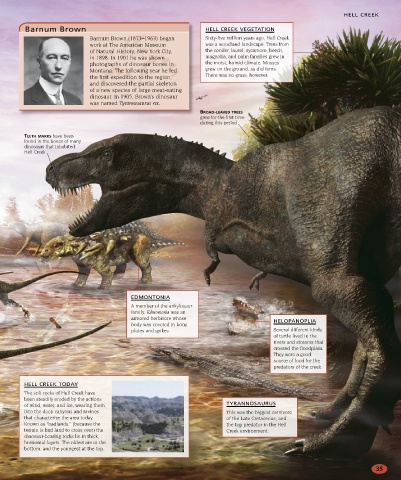
                                                edmontonia
                                                A member of the ankylosaur
                                                family, Edmontonia was an
                                                armored herbivore whose                            helopanoplia
                                                body was covered in bony
                                                plates and spikes.                                 Several different kinds
                                                                                                   of turtle lived in the
                                                                                                   rivers and streams that
                                                                                                   crossed the floodplain.
                                                                                                   They were a good
                                                                                                   source of food for the
                                                                                                   predators of the creek.


          hell creek today
          The soft rocks of Hell Creek have
          been steadily eroded by the actions
          of wind, water, and ice, wearing them                                   tyrannosaurus
          into the deep canyons and ravines                                       This was the biggest carnivore
          that characterize the area today.                                       of the Late Cretaceous, and
          Known as “badlands,” (because the                                       the top predator in the Hell
          terrain is bad land to cross over) the                                  Creek environment.
          dinosaur-bearing rocks lie in thick,
          horizontal layers. The oldest are at the
          bottom, and the youngest at the top.


                                                                                                                                       35

