


Page 39 - DINOSOUR ATLAS
P. 39
south america
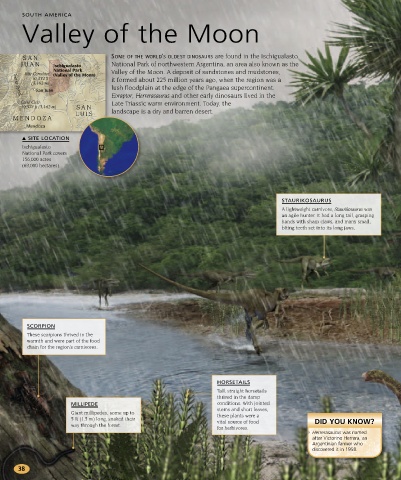
         Valley of the Moon


         3 ! .                           Some of the world’S oldeSt dinoSaurS are found in the Ischigualasto
         * 5 ! .    )SCHIGUALASTO        National Park of northwestern Argentina, an area also known as the
                    .ATIONAL 0ARK        Valley of the Moon. A deposit of sandstones and mudstones,
          .UF $PSSBMJUPT   6ALLEY OF THE -OON
                   GU                    it formed about 225 million years ago, when the region was a
                   N
              3AN *UAN                   lush floodplain at the edge of the Pangaea supercontinent.
                                         Eoraptor, Herrerasaurus and other early dinosaurs lived in the
      4JFSSB 5POUBM
        $FSSP $JFMP                      Late Triassic warm environment. Today, the
               GU        N   3 ! .
                            , 5 ) 3      landscape is a dry and barren desert.
      - % . $ / : !
          -ENDOZA

         u site location
         Ischigualasto
         National Park covers
         156,000 acres
         (63,000 hectares).


                                                                                                     stauriKosaurus
                                                                                                     A lightweight carnivore, Staurikosaurus was
                                                                                                     an agile hunter. It had a long tail, grasping
                                                                                                     hands with sharp claws, and many small,
                                                                                                     biting teeth set into its long jaws.


           scorpion
           These scorpions thrived in the
           warmth and were part of the food
           chain for the region’s carnivores.


                                                                              horsetails
                                                                              Tall, straight horsetails
                                                                              thrived in the damp
                          millipede                                           conditions. With jointed
                                                                              stems and short leaves,
                          Giant millipedes, some up to                        these plants were a
                          5 ft (1.5 m) long, snaked their                     vital source of food               did you know?
                          way through the forest.
                                                                              for herbivores.
                                                                                                               . Herrerasaurus was named
                                                                                                                after Victorino Herrera, an
                                                                                                                Argentinian farmer who
                                                                                                                discovered it in 1958.


       38

