


Page 40 - DINOSOUR ATLAS
P. 40
today’s landscape
                                                                                                 The swamps and forests of the Late Triassic
                                                                                                 are now the rugged, moonlike landscape of
                                                                                                 the Ischigualasto region. It is a desert zone,
                                                                                                 that lies, on average, 4,000 ft (1,200 m) above
                                                                                                 sea level, with little rainfall and sparse
                                                                                                 vegetation. Stream beds are dry for much of
                                                                                                 the time, but when rain does fall they quickly
                                                                                                 fill and flash floods can occur. Since 1971,
                                                                                                 much of the area has been a national park.


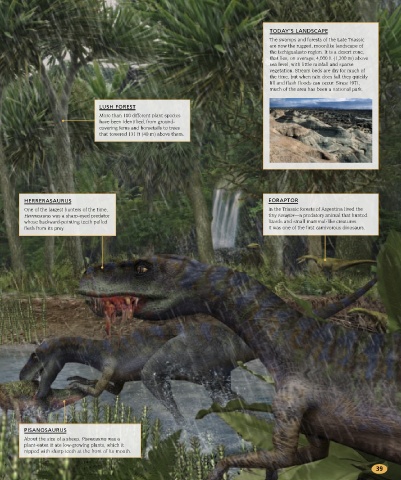
                                    lush forest
                                    More than 100 different plant species
                                    have been identified, from ground-
                                    covering ferns and horsetails to trees
                                    that towered 131 ft (40 m) above them.


          herrerasaurus                                                                          eoraptor
          One of the largest hunters of the time,                                                In the Triassic forests of Argentina lived the
          Herrerasaurus was a sharp-eyed predator                                                tiny Eoraptor—a predatory animal that hunted
          whose backward-pointing teeth pulled                                                   lizards and small mammal-like creatures.
          flesh from its prey.                                                                   It was one of the first carnivorous dinosaurs.


          pisanosaurus
          About the size of a sheep, Pisanosaurus was a
          plant-eater. It ate low-growing plants, which it
          nipped with sharp teeth at the front of its mouth.

                                                                                                                                       39

