


Page 41 - DINOSOUR ATLAS
P. 41
south america
         Araripe Basin                                                                                             C E A R Á
                                                                                                                     Açude Orós


         Fossils From the early cretaceous, about 100 million years ago, have                             Araripe           Juàzeiro do Norte
         been discovered in Brazil’s Araripe Basin. At this time, South America                P I A U Í       Araripe Basin
         lay close to Africa, but as the continents edged apart an inland sea
         formed. Along its edges lived small carnivores, such as Mirischia
         and Santanaraptor, together with large predatory dinosaurs,                                             P E R N A M B U C O
             including the oddly named Irritator. No herbivores have
                 been found, so it is likely that the carnivores lived off                                              São Francisco
                    the area’s fish. Eventually, the sediments on the
                       seabed became rock, creating the limestone of                             u site location
                          the world famous Santana Formation.                                    The Araripe Basin is in northeast Brazil, and covers
                                                                                                 about 3,000 sq miles (8,000 sq km). The Santana
                                                                                                 Formation lies within the Araripe Basin.


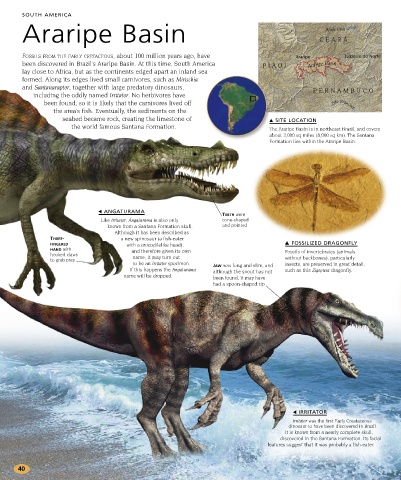
                                    , angaturama
                                                                                TeeTh were
                                     Like Irritator, Angaturama is also only    cone-shaped
                                       known from a Santana Formation skull.    and pointed
                                          Although it has been described as
                   Three-                   a new spinosaur (a fish-eater
                   fingered                   with a crocodilelike head),                              u Fossilized dragonFly
                   hand with                    and therefore given its own                            Fossils of invertebrates (animals
                   hooked claws                 name, it may turn out
                   to grab prey                                                                        without backbones), particularly
                                                to be an Irritator specimen.    Jaw was long and slim, and   insects, are preserved in great detail,
                                               If this happens the Angaturama   although the snout has not   such as this Zigoptera dragonfly.
                                             name will be dropped.           been found, it may have
                                                                             had a spoon-shaped tip


                                                                                                         , irritator
                                                                                                         Irritator was the first Early Creataceous
                                                                                                        dinosaur to have been discovered in Brazil.
                                                                                                       It is known from a nearly complete skull,
                                                                                                     discovered in the Santana Formation. Its facial
                                                                                                features suggest that it was probably a fish-eater.


       40

