


Page 17 - Euclid's Elements of Geometry
P. 17
ST	EW      aþ.


                                                                                            ELEMENTS BOOK 1
                                    ibþ                         angles to the given straight-line AB from the given point


               Τῇ ἄρα δοθείσῃ εὐθείᾳ τῇ ΑΒ ἀπὸ τοῦ πρὸς αὐτῇ makes the adjacent angles equal to one another, each of
            δοθέντος σημείου τοῦ Γ πρὸς ὀρθὰς γωνίας εὐθεῖα γραμμὴ  the equal angles is a right-angle [Def. 1.10]. Thus, each
            ἦκται ἡ ΓΖ· ὅπερ ἔδει ποιῆσαι.                      of the (angles) DCF and FCE is a right-angle.
                                                                   Thus, the straight-line CF has been drawn at right-

                                                                C on it. (Which is) the very thing it was required to do.

                                      .
                                                                                 Proposition 12
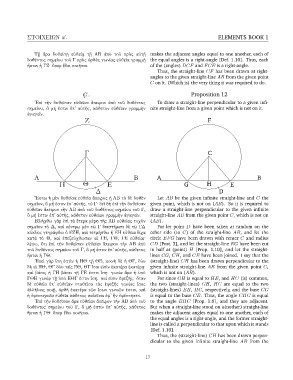
               ᾿Επὶ τὴν δοθεῖσαν εὐθεῖαν ἄπειρον ἀπὸ τοῦ δοθέντος  To draw a straight-line perpendicular to a given infi-
            σημείου, ὃ μή ἐστιν ἐπ᾿ αὐτῆς, κάθετον εὐθεῖαν γραμμὴν nite straight-line from a given point which is not on it.
            ἀγαγεῖν.
                                    Ζ                                                   F


                                    Γ                                                   C


               Α                                         Β         A                                         B
                          Η         Θ         Ε                               G        H         E
                                         ∆                                                   D
               ῎Εστω ἡ μὲν δοθεῖσα εὐθεῖα ἄπειρος ἡ ΑΒ τὸ δὲ δοθὲν  Let AB be the given infinite straight-line and C the
            σημεῖον, ὃ μή ἐστιν ἐπ᾿ αὐτῆς, τὸ Γ· δεῖ δὴ ἐπὶ τὴν δοθεῖσαν given point, which is not on (AB). So it is required to
            εὐθεῖαν ἄπειρον τὴν ΑΒ ἀπὸ τοῦ δοθέντος σημείου τοῦ Γ, draw a straight-line perpendicular to the given infinite
            ὃ μή ἐστιν ἐπ᾿ αὐτῆς, κάθετον εὐθεῖαν γραμμὴν ἀγαγεῖν.  straight-line AB from the given point C, which is not on
               Εἰλήφθω γὰρ ἐπὶ τὰ ἕτερα μέρη τῆς ΑΒ εὐθείας τυχὸν (AB).
            σημεῖον τὸ Δ, καὶ κέντρῳ μὲν τῷ Γ διαστήματι δὲ τῷ ΓΔ  For let point D have been taken at random on the
            κύκλος γεγράφθω ὁ ΕΖΗ, καὶ τετμήσθω ἡ ΕΗ εὐθεῖα δίχα other side (to C) of the straight-line AB, and let the
            κατὰ τὸ Θ, καὶ ἐπεζεύχθωσαν αἱ ΓΗ, ΓΘ, ΓΕ εὐθεῖαι· circle EFG have been drawn with center C and radius
            λέγω, ὅτι ἐπὶ τὴν δοθεῖσαν εὐθεῖαν ἄπειρον τὴν ΑΒ ἀπὸ CD [Post. 3], and let the straight-line EG have been cut
            τοῦ δοθέντος σημείου τοῦ Γ, ὃ μή ἐστιν ἐπ᾿ αὐτῆς, κάθετος in half at (point) H [Prop. 1.10], and let the straight-
            ἦκται ἡ ΓΘ.                                         lines CG, CH, and CE have been joined. I say that the
               ᾿Επεὶ γὰρ ἴση ἐστὶν ἡ ΗΘ τῇ ΘΕ, κοινὴ δὲ ἡ ΘΓ, δύο  (straight-line) CH has been drawn perpendicular to the
            δὴ αἱ ΗΘ, ΘΓ δύο ταῖς ΕΘ, ΘΓ ἴσαι εἱσὶν ἑκατέρα ἑκατέρᾳ· given infinite straight-line AB from the given point C,
            καὶ βάσις ἡ ΓΗ βάσει τῇ ΓΕ ἐστιν ἴση· γωνία ἄρα ἡ ὑπὸ which is not on (AB).
            ΓΘΗ γωνίᾳ τῇ ὑπὸ ΕΘΓ ἐστιν ἴση. καί εἰσιν ἐφεξῆς. ὅταν  For since GH is equal to HE, and HC (is) common,
            δὲ εὐθεῖα ἐπ᾿ εὐθεῖαν σταθεῖσα τὰς ἐφεξῆς γωνίας ἴσας the two (straight-lines) GH, HC are equal to the two
            ἀλλήλαις ποιῇ, ὀρθὴ ἑκατέρα τῶν ἴσων γωνιῶν ἐστιν, καὶ (straight-lines) EH, HC, respectively, and the base CG
            ἡ ἐφεστηκυῖα εὐθεῖα κάθετος καλεῖται ἐφ᾿ ἣν ἐφέστηκεν.  is equal to the base CE. Thus, the angle CHG is equal
               ᾿Επὶ τὴν δοθεῖσαν ἄρα εὐθεῖαν ἄπειρον τὴν ΑΒ ἀπὸ τοῦ to the angle EHC [Prop. 1.8], and they are adjacent.
            δοθέντος σημείου τοῦ Γ, ὃ μή ἐστιν ἐπ᾿ αὐτῆς, κάθετος But when a straight-line stood on a(nother) straight-line
            ἦκται ἡ ΓΘ· ὅπερ ἔδει ποιῆσαι.                      makes the adjacent angles equal to one another, each of
                                                                the equal angles is a right-angle, and the former straight-
                                                                line is called a perpendicular to that upon which it stands
                                                                [Def. 1.10].
                                                                   Thus, the (straight-line) CH has been drawn perpen-
                                                                dicular to the given infinite straight-line AB from the


                                                              17

